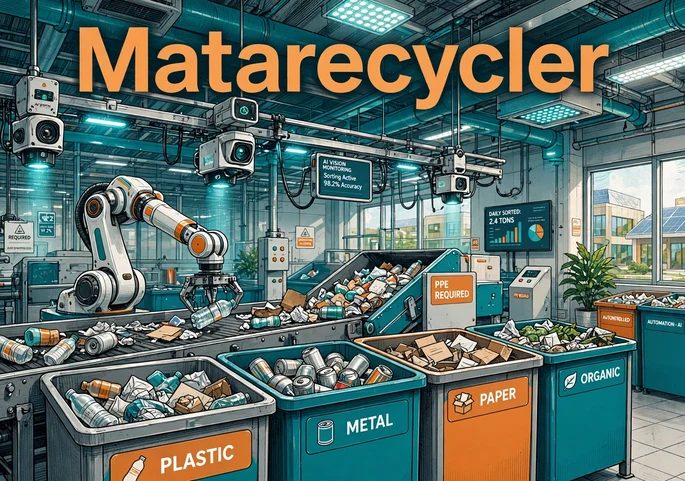
Matarecycler sounds like the name of a product you can buy, but in the way most pages use it, it is the idea of smart recycling built around AI waste sorting, sensors, and real time data. There are no strong official details about a named product, company, or price for Matarecycler, and that gap changes how you should read the many bold promises tied to the name.
That distinction matters because a great deal about the actual technology is proven, while the specific claims about the name are not. The clearest way to read Matarecycler is to split it into two parts: the concept, which is a useful way to describe smart recycling, and the product, for which there is no public evidence you can link back to a company or a price list.
Think of it less as a single invention and more as a new way to combine tools that already exist. Cameras, sensors, and software work together to sort waste faster and cleaner than a person working alone. Those tools are in real recycling plants today, and the rest of this guide explains what they do, how they do it, and where the claims about Matarecycler stop and the evidence begins.
What Is Matarecycler?
The name describes a smart recycling idea that applies AI waste sorting and data to old recycling flows, from a home bin to a large materials recovery facility. There is no single certified definition, and different pages describe it in different ways.
Some pages tie the name to a modern home system, others to a factory line, and still others to a city wide program. That is the first sign that you are reading about a broad concept, not a single product.
Many readers search for one because the name sounds like a specific product. In 2026 the honest picture is closer to a useful label for AI assisted recycling.
| Detail | What pages about the name describe |
|---|---|
| Core idea | AI waste sorting with sensors and real time data |
| Main materials | Plastics, metals, paper, glass, and electronics |
| Users | Households, businesses, factories, and city waste programs |
| Main goal | Less contamination, less landfill, more reusable material |
| Official maker or price list | Not found in our research |
Is It a Real Product or Just a Concept?
It is the idea, not a verified product. A real product would need a few basics, and none of them check out for Matarecycler.
- No named company: The searches we did did not turn up a clear manufacturer, headquarters, or contact process.
- No product listing or price: There is no official price or product name to buy.
- No original audit: There is no independent test or field report tied to the name.
- No proof behind the numbers: The strongest accuracy claims repeat again and again, but they do not link to an audit or a trial.
What is real is the approach behind it. Modern AI sorting is used in real plants. Systems from AMP Robotics, Machinex, and Glacier use cameras and AI to improve sorting by identifying items, measuring the load, and sending ground data. That approach is real and already used in recycling plants today, from companies such as AMP Robotics, Machinex, and Glacier. The sections below focus on what that real technology can and cannot do.
How Does Smart Recycling Work Step by Step?
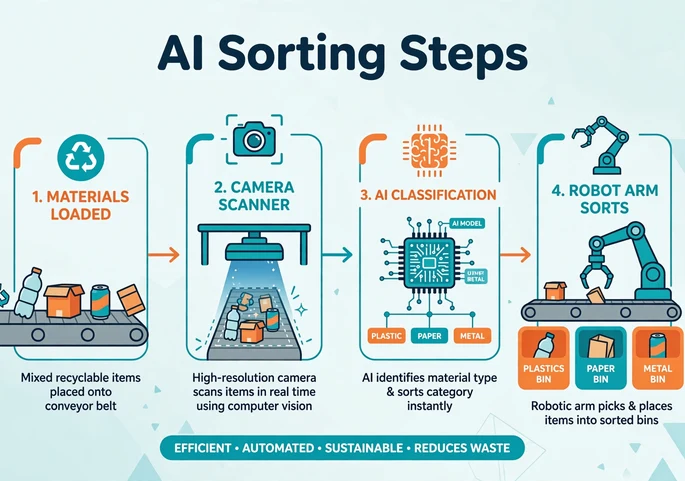
In the way most pages describe Matarecycler, the process follows five steps. They match how modern AI sorting works in real recycling facilities.
- Collection: Waste goes into a bin, a collection truck, or a conveyor belt at a plant. Some smart bins also report how full they are.
- Scanning: Cameras and sensors capture each item. Computer vision studies shape, color, texture, and sometimes the material type.
- Identification: A machine learning model decides what each item is, such as a clear plastic bottle, an aluminum can, or a paper carton.
- Sorting: A robot arm, an air jet, or a diverter moves the item to the right bin or belt.
- Data and reuse: The system logs what passed through, and clean bales of material are sold to manufacturers that turn them into new products.
The data step is easy to overlook. As one AMP Robotics founder has explained, a sorting robot also works as a constant measuring tool, because it records what is in the waste stream while it sorts. That gives managers facts instead of guesses.
Which Technologies Power AI Waste Sorting?
Smart recycling is not one gadget. It is a stack of tools that each do one job.
| Technology | What it does | Real world example |
|---|---|---|
| Computer vision | Recognizes items by shape, color, and texture | Cameras on sorting robots |
| Machine learning | Improves identification as it sees more waste | AMP Robotics, Max-AI from BHS |
| Robotic arms | Pick items off a conveyor belt at high speed | AMP Cortex, Machinex SamurAI, Glacier |
| Near infrared sensors | Detect plastic types by how they reflect light | Optical sorters at recycling plants |
| IoT fill level sensors | Report when a bin is almost full and needs collection | Smart bins from several vendors |
These tools do not replace good collection habits. Clean, dry material still sorts better. Machines can only work with what people put in the bin.
How Much Better Is AI Sorting Than Human Sorting?
It is faster in many cases, and more consistent over a long shift. It is not perfect. Here is what published industry sources report.
| Measure | Human sorter | AI sorting robot |
|---|---|---|
| Picks per minute | About 40 on average, up to 80 for short bursts | 55 to 80 per robot arm; 160 for a dual robot system |
| Stamina | Slows down as the shift goes on | Keeps the same pace all shift |
| Accuracy | Varies with fatigue | Above 90 percent, according to vendor reports |
| Cost | Wages and training | Sometimes around 300,000 US dollars per robot |
| Setup | Hire and train | A learning period; one US facility reported about three months |
Two cautions apply. First, accuracy numbers mostly come from the companies that sell the robots. Second, the same Axios report that listed those costs also quoted a recycling center leader who said a new robot sorted as fast as a person, but its accuracy still needed work. Waste Dive adds that robots are usually placed after optical sorters as quality control, not as a full replacement for people. The honest summary is that AI helps most when it works alongside existing equipment and people.
Why Does Smart Recycling Matter Right Now?
The scale of waste is the reason the technology gets so much attention. The United Nations Environment Programme reports in its Global Waste Management Outlook 2024 that the world made about 2.1 billion tonnes of municipal solid waste in 2023, and that this could reach 3.8 billion tonnes by 2050.
The cost follows the same curve:
- In 2020, the direct global cost of waste management was about 252 billion US dollars a year.
- Adding hidden costs from pollution, health damage, and climate harm raises that to about 361 billion US dollars.
- Without action, the yearly cost could reach 640.3 billion US dollars by 2050.
- A full circular economy path could produce a net gain of about 108.5 billion US dollars a year.
The United States shows how much room there is to improve. The Environmental Protection Agency data cited by Axios puts the US recycling rate for municipal solid waste at about 32 percent, up from 7 percent in 1960. Much of the future growth in waste is expected in fast growing economies in Asia and sub Saharan Africa, where collection systems are often still being built.
What Are the Real Benefits of AI Recycling Systems?
When the technology is installed well and fed clean material, the gains are concrete.
- Cleaner bales: Better sorting means fewer contaminants in the material sold to manufacturers, which raises its value.
- Steady output: Machines do not tire, so quality holds through the whole shift.
- Better data: Managers can see which materials arrive, which items cause jams, and where contamination begins.
- Safer work: Sorting lines are repetitive and can be dangerous. Robots take over the dullest picks.
- Lower sorting cost over time: AMP Robotics has said its goal is to cut the cost of sorting while raising the value of the material.
These benefits support a circular economy, where used materials flow back into production instead of becoming waste.
Where Can Smart Recycling Be Used?
The same core technology fits several settings.
- Homes: Smart bins and apps that show local sorting rules and remind residents of collection days.
- Offices and commercial buildings: Bins that scan items and report what is thrown away, which helps with sustainability reports.
- Factories: Systems that separate scrap metal, plastic, and packaging waste on production lines.
- City recycling plants: Materials recovery facilities, often called MRFs, use robots and sensors to sort mixed household recycling.
- Electronic waste and construction waste: AMP has launched dual robot systems for electronic waste and construction and demolition waste, in addition to municipal waste.
How Does It Compare With Traditional Recycling?
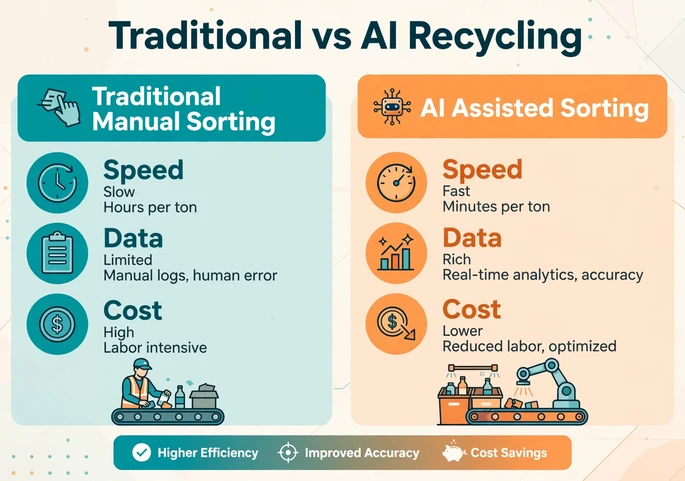
| Feature | Traditional recycling | AI assisted recycling |
|---|---|---|
| Sorting method | People and basic machines | Cameras, AI, and robots working with machines |
| Speed | Slows with fatigue | Steady across a shift |
| Data | Hard to get | Live data on contamination and material mix |
| Accuracy | Varies a lot | Higher, but still needs clean material |
| Cost | Wages and training | Higher up front cost, needs space |
| Flexibility | People adapt quickly | Needs time to learn a new stream |
Notice the last row. Both systems depend on what people put in the bin. Smart technology improves sorting at the plant, but it cannot fully rescue a truck of dirty, mixed waste.
What Are the Challenges and Limits?
The idea is promising, but it does not fix every problem.
- High cost: AI sorting robots are costly to buy, install, and maintain, and some cost hundreds of thousands of dollars. That puts them out of reach for small towns and small recycling plants.
- Accuracy varies: The accuracy of AI sorting depends on the material and how dirty it is. Wet paper, black plastic, and thin film remain difficult.
- Learning time: Systems need time to adapt to a plant’s waste mix. In one case, a robot needed about three months to get up to speed.
- Data and privacy: Cameras and sensors collect data about waste. Plants need clear rules on how that data is stored and shared.
- Worker concerns: Sorting jobs can change when robots enter the line. The technology works best alongside trained people, not by removing people outright.
- Input quality: Dirty or mixed waste lowers results for any system.
- Weak proof for this name: As covered above, the strongest claims tied to the name have no public evidence behind them.
Other limits come from outside the plant. UNEP’s 2024 report points to collection gaps: UNEP notes that billions of people still do not have their waste collected, and about 2.7 billion people lack reliable access. Black plastic and wet paper are hard for sensors to see, and materials rules vary by city, in many places. AI can improve sorting at the plant, but it cannot solve those upstream gaps on its own.
What Does the Future Hold for Smart Recycling?
The direction is clear even if the timeline is not. Robots will keep learning from the waste they see, which improves accuracy over time. Vendors say they can train systems to spot new packaging types as they appear. Plants are adding more sensors and dashboards, so managers can act on data in real time. Smart bin sensors may also help cities plan collection routes, though results will vary by city.
The biggest shift may be in how recycling plants are designed. Industry leaders have described plants with far fewer human sorters, built around vision systems and robots. That future depends on money, skilled technicians, and steady supply of clean material.
How Can You Judge Any Smart Recycling Claim?
Because hype is easy to publish, use this checklist before you trust or share a claim about a recycling product.
| Question | What a solid answer looks like |
|---|---|
| Who makes it? | A named company with a working website and contact details |
| Where does it run? | A named city, plant, or customer you can look up |
| Who tested the results? | An independent audit or study, not only the seller |
| What is the accuracy figure based on? | A defined test with the material types listed |
| What does it cost? | A published price or a clear quote process |
| How old is the data? | Dated, recent results |
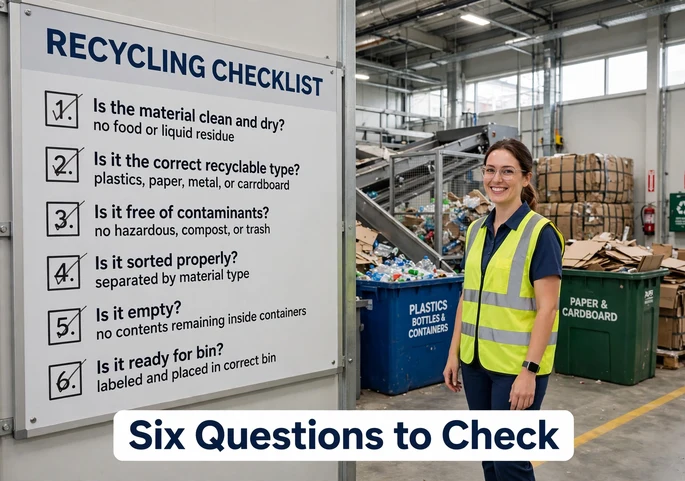
If those answers are missing, the wise move is to treat the claim as unproven.
What Can You Do Today Without Any Smart System?
You do not need a new device to improve recycling at home.
- Sort correctly: Learn the sorting rules in your area.
- Rinse and dry: Wash food and liquids from recyclable items before they go in the bin.
- Keep plastic bags out: Many sorting systems cannot handle them. Use a reuse bag or take them to a collection point.
- Avoid putting tanglers in the bin: Hoses, wire, and clothing wrap around parts of the line and can bring it to a stop.
- Check the local list: Rules change by city, and most cities publish a list online.
- Treat tech as support: Use sort guides and apps as easy helpers, but use the local list as the source of truth.
None of that requires Matarecycler. It requires a line between what the bin takes and what it does not.
Final Thoughts
Matarecycler is best understood as a label for smart recycling, not as a proven product you can buy. The tech behind the label is real. Cameras, sensors, and robots are sorting waste in plants today.
The best way to read the name is to focus on the system rather than the name. Recycle correctly at home, follow your local rules, and ask the six questions above before you share or trust any claim. Most waste still follows the simple path: sort it well, keep it clean, and let proven systems do the rest.
Want to know how AI systems that act on their own could support smarter recycling in the future? Read our guide on AI systems that act on their own. You can also keep up with smart technology news and guides on the Techweeklys homepage.
Frequently Asked Questions
What is Matarecycler?
The name refers to a smart recycling concept that uses AI, cameras, and sensors to identify and sort waste. Descriptions vary, covering smart bins, a tracking app, or a full plant system, and no official maker has been confirmed.
Is it a real company or app?
We found no official company site, price list, or independent audit for it. The technology it describes, AI sorting robots and sensors, is real and used by companies such as AMP Robotics and Machinex.
How accurate is AI waste sorting?
Vendors report accuracy above 90 percent for sorting robots, and a human sorter averages about 40 picks per minute against 55 to 80 for a robot arm. Results depend on the plant, the material, and how clean the input is.
Does smart recycling reduce landfill waste?
It can, by sorting more material correctly and cutting contamination. It works best when people sort carefully, collection systems exist, and plants combine robots with other equipment.
Read More

Related Stories