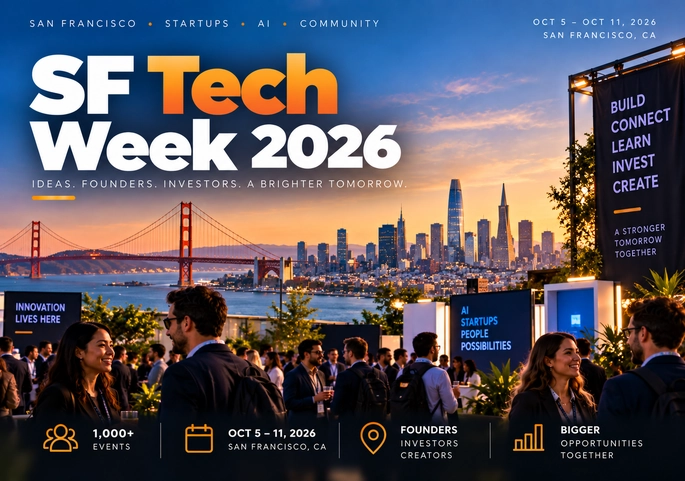
San Francisco’s edition of Tech Week, a decentralized startup and technology festival presented by a16z (Andreessen Horowitz), is SF Tech Week. Instead of one venue and one agenda, SF Tech Week 2026 spreads hundreds of independently hosted events across the city from October 5 to 11, covering everything from sunrise founder runs to late-night hackathons.
There is no ticket that gets you into the whole week. Every event is registered separately, hosted by a different startup, VC firm, or community group, and pulled together onto one public calendar. This guide covers the real dates, how the calendar and registration actually work, the events worth knowing about, and how to build a week that does not turn into constant scrambling between neighborhoods.
For the full picture of how Tech Week works across all four cities, see our Tech Week pillar guide, which covers the Boston, New York, San Francisco, and Los Angeles editions in detail.
When Is SF Tech Week 2026?
SF Tech Week 2026 runs from Sunday, October 5 through Saturday, October 11. The week is organized by a16z, the same firm behind the national Tech Week program, and it follows the same California rollout pattern it has used in past years.
LA Tech Week runs immediately after, from October 12 to 18, and many hosts run events in both cities back to back. Earlier in 2026, Tech Week also expanded into two new cities: Boston Tech Week ran May 26 to 31, and NYC Tech Week ran June 1 to 7.
To be clear on how this compares to its sister week: SF Tech Week and LA Tech Week both run under the same a16z-organized Tech Week program, but they are separate weeks with separate calendars, with SF Tech Week running October 5 to 11 and LA Tech Week following October 12 to 18.
Who Organizes SF Tech Week?
SF Tech Week is presented by a16z, but the firm does not run most of the individual events. Anyone, a startup, a fund, a community group, or a solo organizer, can submit an event for the official calendar. Once approved, that event appears on the public schedule and the host handles their own registration.
The main official calendar lives at luma.com/sftw, where hosts submit and manage their events directly on Luma. Submissions are reviewed on a rolling basis, which is why the calendar keeps filling in new events right up until the week itself.
That rolling review process is also why there is no fixed ‘opening day’ for the calendar itself… GarysGuide also maintains a detailed daily listing of SF Tech Week events, alongside the official Luma calendar.
How Big Is SF Tech Week?
The scale of SF Tech Week is hard to overstate. On a single day, October 5, 2026, the community calendar tracked by GarysGuide listed well over 150 separate events, starting with a 6:30 AM sunrise storytelling session and running past 8:00 PM. Past editions of the week have topped 1,000 total events across the seven days, spread across dozens of neighborhoods.
That density is the whole point of the format. Nobody is meant to attend everything. The week works because there are more good options than any one person can reasonably cover, which pushes attendees to pick a lane and go deep rather than try to sample it all.
What Actually Happens During SF Tech Week
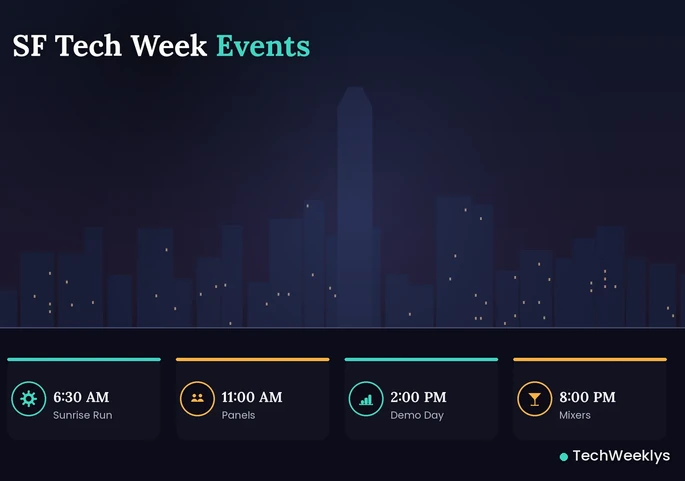
The week is built almost entirely from independently hosted sessions, and the mix covers a wide range of formats:
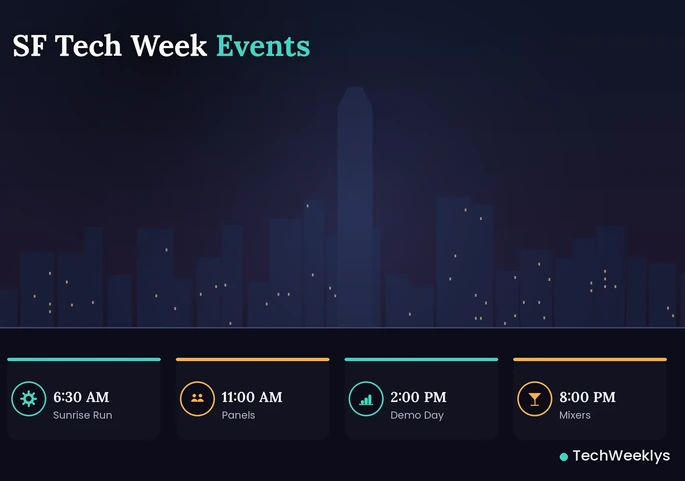
Early morning events. SF Tech Week starts before most conferences would even open doors. Real 2026 listings include a 7:00 AM founders’ run at Embarcadero Plaza, a sunrise cold plunge, and a 7:30 AM run club out of Shack15 on the Ferry Building. Mornings are consistently the least crowded and often the highest-signal part of the week, since everyone there chose to show up early.
Breakfast panels and coffee meetups. Sessions like a breakfast panel on recruiting featuring executives from 1Password, Juicebox, Airbnb, and Sequoia Capital, or founder-focused coffee meetups tied to specific industries like healthtech or hardware, fill the 8:00 to 10:00 AM window.
Daytime panels and workshops. From late morning through the afternoon, the calendar shifts into structured content: fundraising workshops, AI regulation panels, and sessions on scaling teams. A recurring daytime anchor is Claude Founder House, hosted by Anthropic, which has run as an invite-gated event during past SF Tech Week editions.
Demo days and pitch nights. Founders pitch live in front of investors in formats ranging from formal demo nights to comedy-style pitch roasts. a16z’s own speedrun demo day has historically been one of the week’s flagship pitch events.
Evening mixers, dinners, and happy hours. The bulk of the calendar shifts to networking once the workday ends, with events like the Official Tech Week Kickoff, co-hosted by Fireworks, a16z, Vercel, ElevenLabs, and Stripe, drawing some of the week’s biggest crowds.
Hackathons. Multi-hour and overnight builds are common, including events like Hack Alcatraz, run with Cloudflare and Kling AI, and shorter formats built around specific themes like agentic AI or voice tools.
Featured Hosts and Companies at SF Tech Week 2026
The 2026 host wall includes more than 40 organizations, spanning major AI labs, cloud providers, and venture firms. Confirmed hosts and sponsors include a16z (organizer and Platinum sponsor), OpenAI, Anthropic, Google and Google for Startups, AWS, Cloudflare, Mistral, Vercel, Stripe, IBM, HubSpot, Deel, Fenwick, and HSBC Innovation Banking.
Several keynote-level speakers have also been confirmed for 2026, including Arvind Krishna (CEO, IBM), Brian Halligan (co-founder, HubSpot), Biz Stone (co-founder, Twitter), Will Ahmed (founder and CEO, WHOOP), Cristobal Valenzuela (co-CEO, Runway), and a group of a16z general partners across the firm’s investment teams.
Access to the highest-profile events varies. Some, like a Google for Startups session with Google DeepMind, run open registration. Others, particularly events hosted directly by the largest AI labs, tend to be invite-only or require approval before a spot is confirmed.
How Registration Actually Works
SF Tech Week has no central badge or conference pass. Every event lives on its own Luma page, and each host sets their own access rules, which fall into three general tiers:
- Open registration. Anyone can register, and a confirmed spot follows automatically. These events fill up but rarely require an application.
- Approval-gated. Registering puts you in a review queue rather than confirming a spot. The host reviews applications and approves attendees manually, sometimes right up until the event starts.
- Invite-only. These events are not open for public registration at all. Access usually comes through a direct connection to the host or a warm introduction.
In 2025, the highest-demand events at SF Tech Week, including sessions hosted directly by top AI labs and a16z itself, sat in the approval-gated or invite-only tiers. Anyone hoping to attend a specific high-profile event should apply the day it appears on the calendar rather than waiting, since gated events can close applications once they hit capacity.
It’s also worth being clear that there is no single conference pass for the week… Many individual events are free… larger summits and curated dinners can range from around $25 to several hundred dollars
SF Tech Week Neighborhoods and Where Events Cluster
SF Tech Week events are spread across San Francisco, but a few neighborhoods carry a disproportionate share of the calendar:
- SOMA and the Financial District host the highest concentration of panels, breakfasts, and networking events, largely because of the density of coworking spaces and VC offices in the area.
- South Beach and the Embarcadero carry a mix of morning runs, waterfront mixers, and some of the week’s larger evening events.
- Mission District and Dogpatch lean toward founder-focused meetups, smaller dinners, and community-run sessions.
- Jackson Square has become a recurring host neighborhood for AI-focused demo nights and developer meetups.
A handful of events run well outside the city entirely. The Build Better Electronics Manufacturing Summit and a Deep Tech Demo Night, for example, have both been hosted aboard the USS Hornet in Alameda, a reminder to double-check a venue’s actual location before assuming everything is walkable from downtown.
SF Tech Week 2026 Themes to Watch
Based on which hosts and sponsors have confirmed for 2026, a handful of themes are expected to dominate the week’s programming:
| Theme | What to Expect |
|---|---|
| AI Agents and Infrastructure | Sessions on agent reliability, inference costs, and production-grade AI systems |
| AI Safety, Regulation, and Governance | Panels on emerging AI policy and how it affects product roadmaps |
| Fintech and Embedded Finance | Payments, banking infrastructure, and crypto-fintech overlap |
| Global Founders and Cross-Border Growth | US market entry, immigration, and international expansion for founders |
| Deep Tech, Robotics, and Physical AI | Hardware, robotics, and AI applied to physical systems |
| Health Tech and Biotech | AI in drug discovery, clinical research, and preventive health |
How SF Tech Week Compares to LA and NYC Tech Week
All four Tech Week cities run on the same decentralized model, but each has its own character.
SF Tech Week stays closest to the program’s original identity: AI infrastructure, venture capital, and the core Bay Area startup scene. LA Tech Week follows immediately after and leans more toward content, gaming, and consumer technology, industries LA already leads in. NYC Tech Week runs earlier in the year and skews toward fintech, enterprise software, and media, reflecting the industries already headquartered in New York.
For a side-by-side breakdown of how the SF, LA, and NYC editions differ in format, scale, and audience, see our a16z Tech Week Brand comparison guide.
How to Prepare for SF Tech Week 2026
A week this dense rewards planning far more than it rewards showing up and wandering. A few practical steps make a real difference:
Decide your goal before you look at the calendar. Fundraising, hiring, and learning call for very different daily plans. Trying to do all three usually means doing none of them well.
Follow the official calendar early. Following luma.com/sftw means new events land in your notifications as hosts post them, which matters most for open-registration events that fill up fast.
Apply to gated events the day they post. Approval-gated and invite-only events, especially ones hosted by major labs and a16z itself, tend to close applications once they hit capacity.
Cluster your schedule by neighborhood. With events spread across SOMA, the Financial District, South Beach, and beyond, back-to-back sessions in different parts of the city rarely go as planned. Build in real transit time, especially during rush hour.
Pick a short list of must-attend events and leave the rest flexible. The unplanned conversations that happen between scheduled sessions are often where the real value of the week shows up.
Getting Around San Francisco During Tech Week
Most out-of-town attendees fly into SFO or OAK. Within the city, BART, Muni, and Caltrain cover most neighborhood-to-neighborhood travel, and rideshares or scooters help close the last-mile gap between venues. Comfortable shoes matter more than they sound like they would. San Francisco weather shifts quickly within a single day, and evenings can turn cold fast even after a warm afternoon, so packing light layers is worth the small effort.
On that note, what to actually bring comes down to a charger or power bank, a way to exchange contact information quickly, comfortable shoes, and weather-appropriate layers.
Frequently Asked Questions
When is SF Tech Week 2026?
SF Tech Week 2026 runs from Sunday, October 5 through Saturday, October 11.
How do I register for SF Tech Week events?
There is no central badge or conference pass. Every event lives on its own Luma page at luma.com/sftw, and each host sets their own access rules: open registration, approval-gated, or invite-only.
Do I need a ticket for SF Tech Week?
There is no ticket that gets you into the whole week. Every event is registered separately, and many individual events are free, though larger summits and curated dinners can range from around $25 to several hundred dollars.
Where do SF Tech Week events take place?
Events cluster in SOMA and the Financial District, South Beach and the Embarcadero, the Mission District and Dogpatch, and Jackson Square, so cluster your schedule by neighborhood.
SF Tech Week 2026 runs October 5 to 11 as the largest and most technically deep edition of the Tech Week program, with more than 1,000 events expected across Saxn Francisco. The week rewards attendees who pick a lane, follow the Luma calendar early, and apply to gated events the day they post. Whether you’re fundraising, hiring, or learning, cluster your schedule by neighborhood and leave room for the unplanned conversations in between. LA Tech Week follows immediately after for those running the back-to-back circuit.
Read More
What Is Tech Week? A16z’s Guide To All 4 Cities
LA Tech Week: Complete Guide
a16z Tech Week: SF vs LA vs NYC Editions Compared
Seattle Tech Week: Complete Guide

Related Stories