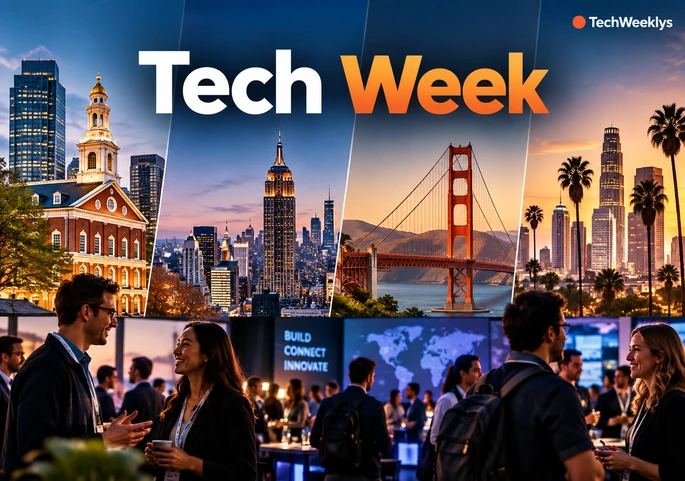
Tech Week is a citywide series of startup and tech events presented by the venture capital firm Andreessen Horowitz, known as a16z. Instead of gathering everyone inside one convention center, Tech Week spreads hundreds of independently hosted events across an entire city for about a week, turning offices, rooftops, university halls, and bars into conference venues. In 2026, the program runs in four cities: Boston, New York, San Francisco, and Los Angeles, with no single organizer running every session and no central venue.
That single idea, no central venue, no one company running every session, is what separates this event from a traditional conference. a16z sets the calendar and the brand. Everyone else builds the actual event.
How Tech Week Started
Tech Week began in 2022, not as a plan but as a test. Katia Ameri, who leads the program at a16z, has said the idea came out of watching what happened to the startup world after COVID. Founders had scattered. Teams that once clustered in a handful of buildings in San Francisco were now remote, spread across cities that never had much of a startup scene before.
a16z was putting real money into Los Angeles at the time, so the firm tried something small there first: a week of events built to reintroduce founders, investors, and operators to each other in person. Ameri and her team pulled the first LA Tech Week together in six weeks, with around 30 events.
It worked better than anyone expected. Roughly 16,000 people signed up within weeks, some flying in from other countries. That response is the reason Tech Week exists as a multi-city program today, and it is the direct answer to why the event started in the first place: a16z needed a low-cost way to rebuild in-person density in a startup world that had gone remote.
From One City to Four
The expansion happened fast once the demand was obvious.
- 2022: The Program launches in Los Angeles as a one-city experiment.
- 2023: San Francisco joins LA, and the two-city format becomes the annual pattern for the next several years.
- 2024 and 2025: New York joins the rotation, and New York Tech Week quickly becomes the largest single edition, with more than 700 events in one week.
- 2026: Boston becomes the fourth city, joining Kendall Square, the Seaport, Back Bay, and Cambridge to the map, alongside returning editions in New York, San Francisco, and Los Angeles.
Each new city followed the same test that LA passed in 2022: does the region already have enough founders, capital, universities, and corporate partners to support a week built entirely on independently hosted events. Boston’s addition in 2026 leaned on its concentration of biotech firms, hospitals, and research universities, which is why its calendar includes tracks you will not find at the other three editions.
Tech Week 2026 Dates, City by City
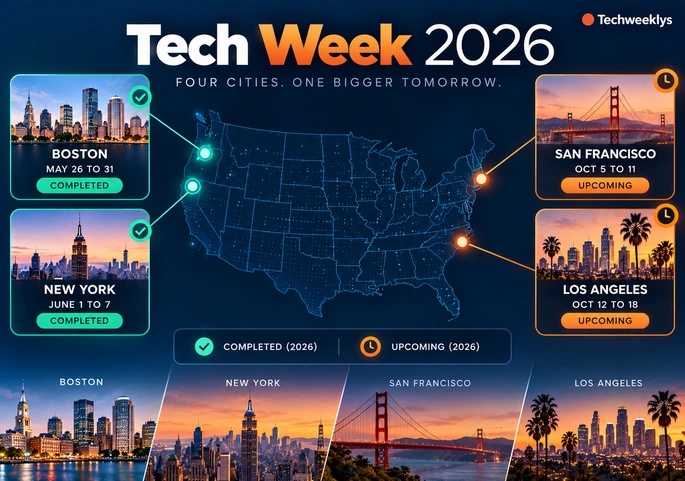
Here is exactly when the 2026 event happens in each city.
| City | 2026 Dates | Status |
|---|---|---|
| Tech Week Boston | May 26 to May 31 | First edition, completed |
| New York Tech Week | June 1 to June 7 | Completed |
| Tech Week SF | October 5 to October 11 | Upcoming |
| Tech Week LA | October 12 to October 18 | Upcoming |
San Francisco and Los Angeles run back to back every year, with SF opening the fall season and LA closing it out the following week. Boston and New York, both newer additions to the rotation, run earlier in the year, in late spring.
Who Organizes Tech Week and How It Actually Works
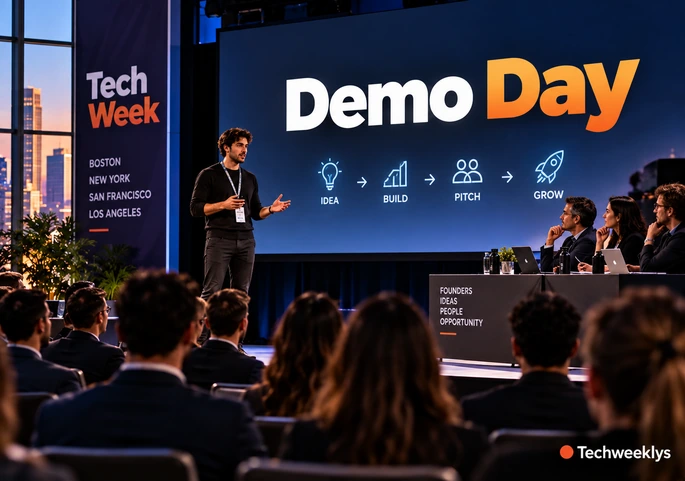
a16z organizes the overall program and calendar, but it does not run most of the individual events itself. Every event during the week is organized and hosted by an outside company, a startup, a fund, or a community group, which submits a proposed event through the official calendar at tech-week.com. Once approved, it appears on the public schedule for that city, and attendees apply directly with the host, who handles registration and check-in.
a16z’s role is closer to a producer than an organizer. The firm runs some flagship programming itself, most notably the SPEEDRUN demo day, where dozens of founders pitch investors in rapid succession, but the bulk of the week’s content comes from outside companies choosing to host something. For a closer look at how founder pitch events and demo days work across the different cities, see our upcoming startup demo days and founder events guide.
Events are grouped into tracks so attendees can filter by what they actually want to see. Recurring tracks across cities include:
- AI and Infrastructure
- Bio and Health
- Fintech
- Hackathons
- Deep Tech and Robotics
- Dedicated sessions for students, founders, engineers, and investors
Boston’s 2026 calendar added a track most other cities do not run: a disability tech investor summit hosted with MassBio, reflecting the city’s healthcare research base.
What Actually Happens During Tech Week
Ask anyone who has attended and the format looks less like a conference and more like a week-long crawl through a city’s startup scene. A typical schedule mixes:
- Panels and fireside chats, often with founders or operators from companies like Venmo, Cal.com, or major AI labs
- Demo days, where early-stage startups pitch to rooms full of investors. SPEEDRUN alone has put more than 60 founders on stage in a single SF Tech Week
- Hackathons, sometimes run overnight, built around a specific theme like multi-agent AI systems. Our upcoming tech hackathons guide covers the recurring hackathon formats across Boston, NYC, and Atlanta in more detail
- Office tours, including factory walkthroughs at companies building physical hardware
- Mixers and dinners, some open to anyone on the calendar, others built around a narrow group, such as investor-only dinners or vertical-specific gatherings for people working in defense tech or biotech
The through line across all of it is density. The event works because it puts thousands of founders, operators, and investors in the same city at the same time, so meetings that would normally take months of email back and forth happen instead over a rooftop mixer on a Tuesday night.
How Big Is Tech Week, Really
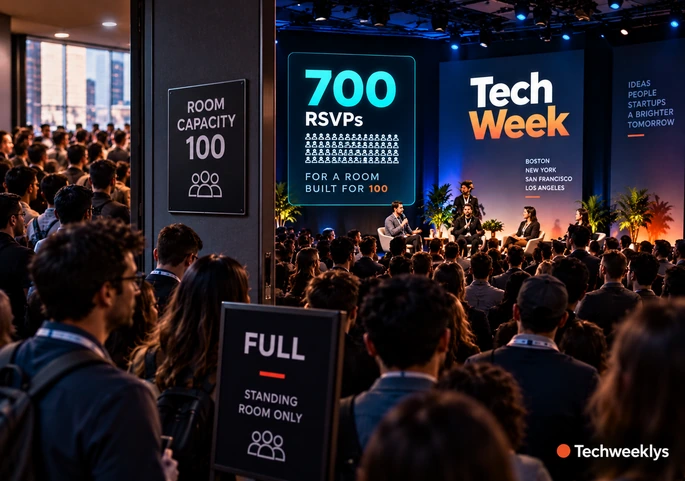
The numbers back up the claim that this is one of the largest tech gatherings in the country, even without a single physical venue.
SF and LA Tech Week combined saw more than 1,000 events in a single year across the Bay Area and Los Angeles, making it, by event count, one of the biggest tech gatherings in the country and a fair answer to how big national tech week programming really is.
- SF Tech Week 2025 drew an estimated 8,400 attendees, speakers, and sponsors.
- Boston Tech Week’s first edition in 2026 launched with 572 events and more than 80 founding hosts in under a week.
- Individual events can dramatically outgrow their venue. One AI panel during a recent SF Tech Week drew nearly 700 RSVPs for a room built for 100 people, a reminder that popularity on the calendar does not always match room capacity.
- By event count, New York Tech Week has recently overtaken every other city, while San Francisco and Los Angeles remain the longest-running editions, having run every year since Tech Week expanded beyond Los Angeles in 2023.
What Makes Each City’s Edition Different
The four cities share a format but not a personality.
Boston Tech Week leans into biotech, health, and deep tech, drawing on the city’s hospitals, universities, and research labs. Its 2026 debut included a dedicated disability tech investor summit, a track no other city runs.
New York Tech Week has grown into the largest single edition by event count, with a strong fintech and fashion tech presence alongside the AI programming every city shares. Brooklyn’s own standalone conference, the Brooklyn Tech Expo, often runs during the same week as a companion event.
Tech Week SF stays closest to the event’s original identity: AI infrastructure, venture capital, and the core Bay Area startup scene, with SPEEDRUN as its signature event.
Tech Week LA picks up where SF leaves off each October, with more emphasis on content, gaming, and consumer technology, reflecting the industries LA already leads in outside of pure tech.
For a full side-by-side breakdown of how these editions differ in scale, cost, and audience, see our a16z Tech Week brand comparison.
Is this event Free to Attend, and How Do You Host an Event
Cost depends entirely on the event, since a16z does not set pricing for the whole week. Many panels, mixers, and community meetups are free, while some dinners and invite-only sessions are limited to specific guest lists. Each host sets their own registration terms, so checking the individual event listing is the only reliable way to know the price before applying.
Hosting works the same way attending does: through the individual company, not through a16z directly. Companies and organizations submit event proposals directly through tech-week.com, submissions are reviewed on a rolling basis, and approved events are added to the public calendar for that city.
How to Get the Most Out of Week
Attending without a plan is the fastest way to waste a week that only happens once a year in your city.
- Decide what you are actually there for before you look at the calendar. Fundraising, hiring, and learning call for different events, and trying to do all three usually means doing none of them well.
- Use the track filters on the official calendar instead of relying on word of mouth. The calendar for each city typically opens for public browsing in the weeks before the event.
- Block real travel time between venues. Events are spread across neighborhoods, and back-to-back sessions on opposite sides of a city rarely go as planned.
- Pick a short list of must-attend events and build the rest of your week around them, rather than trying to hit everything on the calendar.
- Apply early to smaller, invite-style events, such as investor dinners or vertical-specific meetups. These fill up faster than open panels and often deliver more direct value than a large keynote.

Related Stories