Every year, thousands of students trade a weekend of sleep for the chance to build working software from nothing at tech hackathons, the 24 to 48 hour build sprints that have become a rite of passage in the tech world. Teams form on Friday, demos happen on Sunday, and somewhere in between, powered by free food and sponsor APIs, real products are born. This guide rounds up the biggest and most welcoming hackathons across the US, city by city, so you can pick the right one for your skill level.
What Is a Tech Hackathon and How Does It Work?
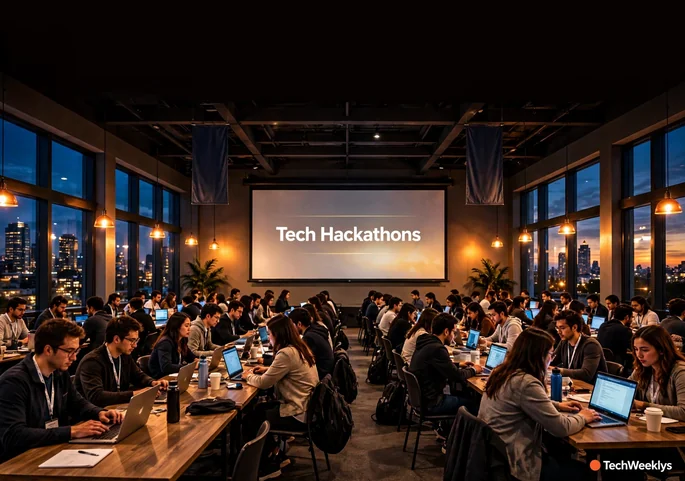
A hackathon is a time boxed invention marathon. You show up, usually on a Friday evening, form a team of two to four people, and spend the next day or two designing and building a working prototype around a theme or an open prompt. Mentors and sponsor engineers roam the room to help you get unstuck. When time runs out, every team demos what it built in a few short minutes, and judges pick winners across categories like best overall, best design and best use of a sponsor’s technology.
That format is the heart of modern tech hackathons: intense, collaborative and open to anyone willing to build. Most student editions are free, with meals, swag and workspace covered by sponsors. It is the same grassroots energy that powers the wider tech week movement, which our What Is Tech Week pillar breaks down city by city. Below are the flagship events worth knowing.
The Biggest Tech Hackathons in the US
The events below are the ones with real scale: hundreds or thousands of participants, serious prize pools and recruiter packed demo floors. Each has its own character, so read the city notes and pick the vibe that fits you.
San Francisco Bay Area
The Bay Area hosts the most famous student hackathon in the country. TreeHacks, Stanford’s premier hackathon, brought together about 1,000 builders selected from 15,000 applicants for its February 2026 edition, with $500,000 in prizes across its 36 hour weekend. Keynotes have included OpenAI CEO Sam Altman and Y Combinator CEO Garry Tan, which tells you the caliber of the room. Across the bay, UC Berkeley runs Cal Hacks, another long running flagship. For working engineers rather than students, the DeveloperWeek 2026 Hackathon ran in person at the San Jose Convention Center from February 18 to 20, with an online leg from February 2 to 20, drawing developers into sponsor challenges around AI and dev tools. The Bay Area’s density of builders is unmatched, which is also why our SF Tech Week guide covers the region’s bigger annual gatherings.
Boston
HackMIT is the largest undergraduate hackathon at MIT and one of the oldest collegiate hackathons in the country, drawing more than 1,000 students to Cambridge every September for a weekend of workshops, talks and building. Organized entirely by MIT students, it pairs the classic build sprint with sponsor workshops and mentorship from industry engineers. Boston’s deep student talent pool keeps it competitive year after year; our Boston Tech Week guide covers the city’s wider tech calendar.
New York City
New York’s hackathon scene splits between student and professional events. The DeveloperWeek New York 2026 hackathon ran alongside the conference at the TWA Hotel at JFK Airport on June 9 and 10, with more than 1,000 participants building across two days of AI and cloud challenges. For something more civic minded, the New York Public Library hosted its inaugural Built for NYC AI hackathon in August 2026, asking hackers to solve real city challenges. New York’s scale means there is almost always something running; our NYC Tech Week guide rounds up the city’s biggest annual tech gatherings.
Atlanta
Atlanta’s flagship is HackGT, the free 36 hour hackathon run by Georgia Tech’s HexLabs. It draws more than 1,000 hackers from universities across the country each fall, with tens of thousands of dollars in prizes and automatic entry into Georgia Tech’s Create-X Startup Launch for top teams. The city also hosts Hacklanta, which ran October 9 to 11 in 2026 with $20,000 in prizes. Atlanta’s builder culture runs deep, as our Atlanta Tech Week guide shows.
Philadelphia
Philadelphia is home to PennApps, the nation’s first student run college hackathon and still one of the biggest. The fall edition draws around 1,200 students and 40 sponsors to Penn’s campus, with more than $80,000 in prizes across 36 hours of building. UPenn students are admitted automatically, and everyone else applies. If you want the classic big tent collegiate hackathon, this is it; our Philly Tech Week guide covers the rest of the city’s tech scene.
Los Angeles
LA Hacks is one of the largest student run hackathons in the US. The 2026 edition ran April 24 to 26 at UCLA’s Pauley Pavilion, bringing together more than 1,000 participants for 36 hours of building across tracks in education, sustainability, healthcare and lifestyle. Hardware sponsors showed up in force: ASUS equipped up to 40 teams with desktop AI supercomputers for its company challenge. Our LA Tech Week guide has more on the city’s startup scene.
Seattle
The Pacific Northwest’s largest hackathon is DubHacks, run by University of Washington students. The 2026 edition took over the HUB North Ballroom on October 17 and 18 with the theme “Let’s Get Cookin”, and the free event has served more than 13,000 students across 11 flagship editions. Its sister program, DubHacks Next, is a 16 week startup incubator whose alumni have raised more than $5 million. Seattle’s builder community is tight knit; our Seattle Tech Week guide covers the bigger picture.
Miami
Miami’s entry is ShellHacks, which bills itself as Florida’s largest hackathon. The 2026 edition marked its 10th anniversary, running September 25 to 27 with 880 participants competing for $47,150 in prizes. It anchors South Florida’s student builder scene. For the city’s broader tech calendar, see our Miami Tech Week guide.
What Do You Win at Tech Hackathons?

Cash is only part of it. Top prizes at the big collegiate events run from tens of thousands of dollars to six figures in total value. Sponsor tracks add hardware, cloud credits and API access. But the real prizes are often non monetary: top HackGT teams earn automatic entry into Georgia Tech’s Create-X Startup Launch accelerator, DubHacks feeds teams into its Next incubator, and recruiters from sponsor companies scout the demo floor for interns and new grads. Many participants say the portfolio project and the network matter more than the check.
Do You Need to Know How to Code to Join?

No. Most student hackathons explicitly welcome beginners, and many run workshops and mentorship all weekend so first timers can learn as they build. The classic team formula is hacker, hipster and hustler: one person builds, one designs, one pitches. Designers, domain experts and storytellers all have a place; some of the best demos win on presentation rather than technical depth. Beginner focused series like CodeDay design the entire format around first time coders.
Online Hackathons Worth Trying
If travel is not an option, the virtual circuit is serious. Major League Hacking runs Global Hack Week, a recurring series of week long online hackathons with themed tracks, workshops and swag for participants anywhere in the world. Devpost hosts hundreds of online challenges year round, from company sponsored API contests with cash prizes to month long social impact builds like university run sustainability hackathons. The format is the same as the in person weekend, minus the free pizza: you form a team on Discord, build in the open and submit a demo video.
How to Find Tech Hackathons Near You
Two platforms list nearly everything. Devpost is the largest hackathon hosting platform, where you can filter upcoming events by date and prize. Major League Hacking runs the official student hackathon season at mlh.io, with hundreds of member events plus its own virtual Global Hack Week series. Set alerts on both, because the popular ones fill fast: TreeHacks drew 15,000 applicants for 1,000 spots in 2026.
Frequently Asked Questions
What is a tech hackathon?
A tech hackathon is a time boxed event, usually 24 to 48 hours, where teams design and build a working technology project from scratch, then demo it to judges. Most are free, include meals, and welcome beginners.
How long do they last?
Most tech hackathons run 24 to 48 hours over a weekend. Some, like the DeveloperWeek online leg, stretch over several weeks, while one day mini hackathons are common on the Major League Hacking circuit.
Are they free to attend?
Nearly all student editions are free, with food, swag and workspace covered by sponsors. Some even reimburse travel. Professional hackathons attached to conferences may require a ticket.
What should I bring to a hackathon?
A laptop and charger, headphones, toiletries and something to sleep on: most venues expect you to crash on site. Bring a team if you have one, but most events run team formation sessions for solo hackers.
Final Word
Tech hackathons compress months of learning into a single weekend: you ship something real, meet collaborators and get judged by people who build for a living. Whether you start with a 1,000 person flagship or a small local hack day, the formula works. For year round coverage of the events shaping the tech world, bookmark the TechWeeklys homepage and keep exploring the guides below.
Read More

Related Stories