A founder types two words into a search bar, hoping for a quick answer about funding a company without outside money. The phrase startup booted sits at the center of a common search tangle. It can mean a bootstrapped startup, a consulting brand called StartupBooted, or a fundraising approach that tries to stay close to bootstrapping while still raising capital. This guide untangles all three, explains the services and prices the brand publishes, and walks through the numbers a founder actually needs: how dilution works, how to build a simple financial model, and how to check whether a 10,000 dollar service is worth it.
What Does Startup Booted Mean?
Startup booted is shorthand for a bootstrapped startup, meaning a company funded by founder savings and revenue instead of outside investors. Bootstrapping is the established term; booted is the informal search shorthand for it. The two meanings of startup booted are easy to confuse because the same phrase also names a consulting company, StartupBooted.com, which sells fundraising and financial modeling services to founders.
That overlap explains why search results look messy. Some pages explain a funding approach. Others review a service. A reader who wants the meaning and a reader who wants a price land on the same phrase.
| Meaning | What it refers to | Where you see it |
|---|---|---|
| Bootstrapping shorthand | Growing a company from savings and revenue, then raising only when it helps | Founder blogs and finance guides |
| StartupBooted.com | A startup consulting brand with three paid services | The official website and review articles |
| Related names | Sites such as StartupBootedFundraising.com appear in some reviews | We could not confirm how they relate to the main site |
The word booted is not a formal finance term. You will not find it in accounting rules or investor documents. Use bootstrapped when you talk to investors, accountants, or lawyers, and treat booted as a search phrase, not a legal label.
What Is StartupBooted.com and What Does It Sell?
The official site calls itself a one stop guide for business growth and offers three services: an investor pitch deck, financial modeling and budgeting, and a fundraising strategy. The homepage describes a team of experienced consultants and uses plain language about helping founders through the fundraising process.
| Service | What the official page describes | Starting price |
|---|---|---|
| Investor pitch deck | Designing a deck around your story for investors | $5,000 as reported by review sites; we did not see it on the pages we read |
| Financial modeling and budgeting | Financial models, strategic budgets, scenario analysis, and ongoing guidance | $10,000, stated on the official page |
| Fundraising strategy | Strategic planning, pitch optimization, targeted investor outreach, and data driven insights | $2,000, stated on the official page |

Three details help you judge the brand. First, the homepage describes a team of experienced consultants but does not name founders, show individual bios, or list client logos. Second, the official page shows no client reviews or testimonials, so independent review articles become the main second source. Third, pricing is split: the financial modeling and fundraising strategy prices appear on the official site, while the pitch deck price appears in review articles instead.
What Is a Startup Booted Fundraising Strategy?
A startup booted fundraising strategy is a founder led way to raise capital while staying close to bootstrapping. Instead of chasing a large venture round, you raise a small amount from investors who add more than money, keep control of decisions, and use revenue to cover as much growth as possible.
It sits between two familiar paths:
| Factor | Pure bootstrapping | Booted approach | Venture backed |
|---|---|---|---|
| Main source of money | Savings and revenue | Revenue plus small, chosen outside capital | Investors who buy equity |
| Founder control | Full | High | Shared with investors |
| Growth speed | Set by cash flow | Moderate | Fast, if capital allows |
| Dilution | None | Low | Rises with each round |
| Main risk | Slow growth, personal financial strain | Limited cash against better funded rivals | Pressure to hit aggressive targets |
This path suits businesses with early revenue, steady customer demand, and modest upfront costs, such as software, services, and digital products. It fits less well when the business needs heavy spending before its first sale, such as hardware, regulated products, or large inventory.
How Do You Execute a Startup Booted Fundraising Strategy Step by Step?
The official page lists seven steps. Here they are in plain language, with the details that matter at each stage.
- Validate the problem. Talk to buyers, test a landing page, or take pre orders before you build much.
- Build a product that sells. Aim for a small version that earns money, because revenue becomes your proof.
- Reinvest revenue. Put early profits into the channels and features that already work.
- Consider money that does not dilute you. Revenue based financing, grants, startup prizes, and customer prepayments can add cash without selling shares.
- Write the plan. State why you are raising, how much, what it will fund, and what result you expect six to twelve months later.
- Target strategic investors. Prefer people who bring customers, industry knowledge, or distribution, not just cash.
- Track the numbers. Watch revenue growth, customer acquisition cost, churn, and runway every month.
The official page leaves out four things you should add yourself. Learn the terms of any instrument before you sign, because a SAFE, convertible note, and priced round behave differently later. Check whether a fundraising strategy service introduces you to investors or only prepares materials. Decide how much control you will give up for each dollar. And set a clear rule for when to stop raising and return to building.
Which Funding Options Can a Booted Founder Use?
| Option | How it works | Main trade off |
|---|---|---|
| Self funding | Savings, family support, or retained revenue | Full control, but personal financial risk |
| Customer prepayments | Annual plans or deposits paid upfront | Improves cash, but creates service obligations |
| Revenue based financing | You repay a share of monthly revenue | Reduces cash flow until repaid |
| Grants and prizes | Competitive funding for eligible projects | Slow applications and limited eligibility |
| SAFE | A contract that converts to shares in a later priced round | Fast and simple, but the valuation cap shapes future dilution |
| Convertible note | Debt that converts to shares later | Carries interest and a due date |
| Priced equity round | Investors buy shares at an agreed valuation | More legal terms and often a board seat |
| Bank or government backed loan | Repayable debt with a plan | No ownership loss, but fixed repayments |
For grants, check the current rules on the official agency website, because windows and eligibility change often. For SAFEs and notes, ask a lawyer to explain the cap, discount, and conversion trigger before you agree to them.
How Does Dilution Work in Real Numbers?
Every time a company sells new shares, existing owners hold a smaller percentage. Here is a simple example. Suppose a founder owns 100 shares of a company with 100 shares in total, so the founder owns 100 percent. The company then sells 25 new shares to an investor. The total becomes 125 shares, and the founder now holds 100 of 125, which is 80 percent. Nothing was taken from the founder. The slice is smaller because the pie is bigger.
A cap on a SAFE works in a similar way. It sets a maximum valuation at which the money converts into shares. A low cap means the investor gets more shares for the same money, so the founder is diluted more at conversion. That is why the cap matters more than the headline amount.
When Should a Bootstrapped Startup Raise Money?
Ask what the money will buy that your revenue cannot. If you can name a specific milestone, such as hiring a salesperson who already has a pipeline, buying stock for confirmed orders, or finishing a feature customers have already paid for, raising can make sense. If the answer is vague, such as growing faster, the money will usually disappear without a clear result.
Signs you are in a stronger position:
- Revenue has grown for several months, not in one spike.
- Customers stay, so churn is steady or falling.
- At least one sales channel works and would grow with more money.
- You have roughly 9 to 12 months of runway, so you can negotiate without panic.
The current market adds a reason for care. Crunchbase counted 159 billion dollars of global venture funding in a recent quarter, yet most of it went to a small group of large AI companies. For an ordinary early startup, the picture is different: total funding looks strong, but the share reaching smaller companies is thinner. A booted founder should plan as if outside money is scarce, even when headline totals look large.
What Is Startup Booted Financial Modeling?
Startup booted financial modeling means building a forecast of revenue, costs, and cash for a company that plans to fund growth mostly from its own revenue. The model shows how long cash lasts, when the business breaks even, and what happens if sales, price, or costs change.
A model is not the same as a budget. Use this table to keep the tools straight.
| Tool | Main question it answers |
|---|---|
| Bookkeeping | What already happened? |
| Budget | What do we plan to earn and spend? |
| Forecast | What might happen on today’s assumptions? |
| Financial model | What changes if an important assumption changes? |
A booted model also differs from a venture style model. The venture version assumes future funding will cover a gap. A booted model cannot assume that. It must show how revenue covers costs, and where the cash runs out if it does not.
| Dimension | Booted model | Venture style model |
|---|---|---|
| Revenue assumption | Revenue funds operations | Future funding covers the gap |
| Growth style | Steady and proven by revenue | Fast, market share first |
| Key metrics | Runway, break even, gross margin | Growth rate, market size |
| Typical failure | Cash runs out before break even | Capital runs out before product market fit |
What Should the Model Help You Decide?
Build the model around a decision, not around a template. A founder rarely needs a 20 tab workbook. Five questions cover most early decisions.
| Founder decision | Useful model output |
|---|---|
| Can we hire another person? | Ending cash after adding payroll |
| Can we cut our price? | New break even and contribution per sale |
| Can we spend more on marketing? | Cash impact and expected new customers |
| Can we buy more inventory? | Cash needed and purchase timing |
| What if sales disappoint? | Downside case cash balance |
How Do You Build a Startup Booted Financial Model Step by Step?
Google Sheets or Excel is enough. Follow these eight steps.
- Write the decision first. One sentence, such as: Can we afford a part time sales hire in month six?
- Enter your real starting position. Cash in the bank, bills due, unpaid invoices, subscriptions, payroll, and debt.
- Build revenue from drivers. For software: customers multiplied by price. For services: projects multiplied by fee. For a store: orders multiplied by average order value.
- Sort costs by how they behave. Fixed costs stay put. Variable costs rise with sales. Step costs jump when you hire or buy equipment.
- Model when cash actually moves. Customers who pay in 30 days and suppliers who want money now create a gap, even for a profitable business.
- Connect the outputs. Changing the number of customers should flow through to revenue, variable costs, profit, and cash.
- Calculate break even and runway. The U.S. Small Business Administration gives the unit formula as fixed costs divided by price minus variable cost per unit. Runway is cash divided by monthly net burn.
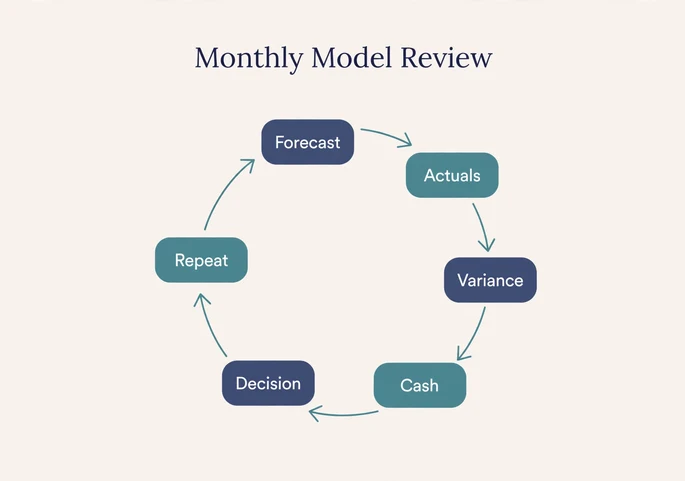
- Run three cases and compare to actuals. Build a base case, a downside case, and an upside case that is still realistic, then check the model against real results every month.
What Does a Worked Example Look Like?
Here is a made up software company. It charges 59 dollars a month, starts with 30,000 dollars in cash, and adds 8 customers a month. Fixed costs are 3,500 dollars a month, and each customer costs 7.08 dollars a month to serve.
| Month | Customers | Revenue | Total costs | Net cash flow | Cash at month end |
|---|---|---|---|---|---|
| 1 | 8 | $472 | $3,557 | ($3,085) | $26,915 |
| 3 | 24 | $1,416 | $3,670 | ($2,254) | $21,992 |
| 6 | 48 | $2,832 | $3,840 | ($1,008) | $17,723 |
| 8 | 64 | $3,776 | $3,953 | ($177) | $16,953 |
| 9 | 72 | $4,248 | $4,010 | $238 | $17,191 |
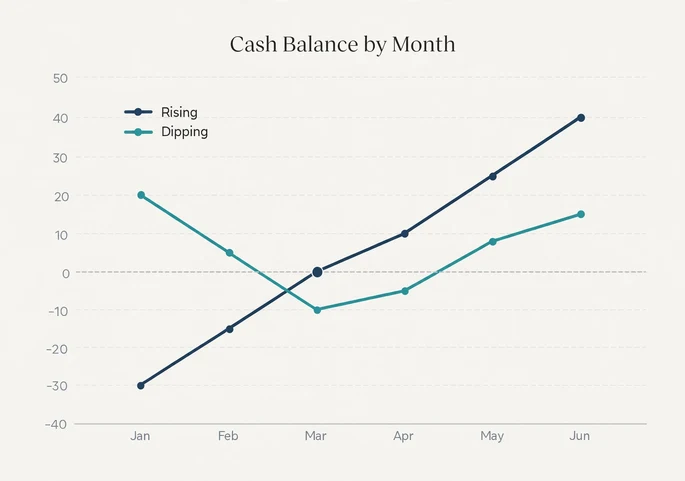
Each customer contributes about 51.92 dollars after variable costs, so break even needs 68 customers: 3,500 divided by 51.92 equals 67.4, rounded up to 68. The company reaches that point in month nine, when it has 72 customers.
Now test the downside. If the company adds only 4 customers a month, break even arrives in month 17, and cash falls to about 6,200 dollars in month 16 before it turns. That gap is the risk a booted founder must see early. A model that shows only the good case hides it.
Which Assumptions Can You Trust?
Not every input deserves the same faith. Rank each one on a simple ladder.
- Actual: a number from your own records, such as last month’s payroll.
- Committed: a signed lease or contracted software price.
- Evidence based: supported by current data, such as a measured conversion rate.
- Reasoned estimate: logical, but with little direct proof.
- Hypothesis: untested, such as an assumed viral growth rate.
Stress test the inputs that are both shaky and large. A small office supply guess barely matters. A wrong price or a wrong churn rate changes everything. If a single assumption decides the answer, get real data for it before you trust the model.
Why Can a Profitable Startup Still Run Out of Cash?
Profit and cash measure different things. Imagine a business finishes 50,000 dollars of work and records a profit, but customers pay in 60 days while suppliers want money in 14 days. The books show a profit, the bank shows a falling balance, and the business still needs cash to pay staff and rent. This timing gap is common for service businesses and stores that buy stock before they sell it. A model that tracks cash by month, not only profit, catches it before it becomes a crisis.
Which Metrics Do Investors Ask About?
| Metric | What it tells an investor | Basic formula |
|---|---|---|
| Monthly recurring revenue and growth | Whether demand is real | Sum of monthly subscriptions |
| Churn rate | Whether customers stay | Customers lost divided by starting customers |
| Customer acquisition cost (CAC) | Cost to win one customer | Sales and marketing spend divided by new customers |
| Lifetime value (LTV) | Gross profit from a customer over time | Average revenue per customer times gross margin divided by monthly churn |
| Payback period | Months to recover CAC | CAC divided by monthly gross profit per customer |
| Burn rate and runway | How long cash lasts | Cash divided by monthly net burn |
A ratio of LTV to CAC near 3 to 1 is a common rough guide, but the right target depends on your model. A subscription business with low churn can live with a lower ratio than a business that loses customers quickly.
How Does the Model Change by Startup Type?
| Startup type | Drivers to model |
|---|---|
| Software | Customers, price, churn, expansion, support cost |
| Agency or service | Clients, projects, project value, staff capacity |
| Online store | Orders, order value, product cost, returns, inventory |
| Marketplace | Transactions, take rate, active buyers and sellers |
Do not borrow churn or margin figures from another business. Use your own data, or label the number as a guess and test it.
Can AI Help Build the Model?
Yes, as an assistant. An AI tool can explain formulas, draft a layout, suggest scenarios, and spot obvious errors. It cannot know your price, your churn, or your costs. Treat any model an AI builds as a draft. Check every formula, every input, and every total against your own records before you show it to anyone.
Do You Need to Pay 10,000 Dollars for a Model?
Not always. The official StartupBooted page lists startup booted financial modeling and budgeting from 10,000 dollars. That price may suit a founder who needs a polished investor model and has the budget, but most early founders can start cheaper.
| Route | Best when | Watch out for |
|---|---|---|
| Do it yourself in a spreadsheet | You are pre revenue or early, and the model supports your own decisions | Hidden formula errors; ask someone to review it |
| Accountant or fractional finance help | Your books are complex or you need tax and accounting input | Scope limited to compliance, not strategy |
| Consultant such as StartupBooted | You need a polished investor model and have budget | Price, ownership of the file, and no guarantee of funding |
| Downloaded template | You want a head start | Drivers that do not match your business |
Whatever you choose, ask for a model you can read, edit, and update yourself. If only the consultant can change it, you do not own your own numbers.
Is StartupBooted Legit? How to Check Before You Pay
The fair answer for startup booted as a brand is that it has an active website, a clear service list, and published prices for two of its three services, but it shows no team names, no client reviews on its own site, and no samples of its work. That is not proof of a problem, but it means a founder should check more before paying a four or five figure fee.
- Who exactly will build my model or deck, and what is their experience?
- Which legal company signs the agreement, and where is it registered?
- Can I see a sample model or deck with client details hidden?
- Can I speak with a past client at a similar stage?
- What does the price include, and what costs extra?
- Will I own the files and be able to edit them?
- How many revisions are included?
- Is any work outsourced, and who is responsible for quality?
- What is the refund or cancellation policy?
- What do you promise, and what do you refuse to promise?
Be wary of anyone who guarantees funding. Investors decide, not consultants.
Which Real Companies Grew With Little Outside Capital?
Mailchimp is the standard example. Founded in 2001, it never raised venture capital and sold to Intuit in 2021 for about 12 billion dollars. It grew from a side project into a large email business on customer revenue.
Be careful with longer lists. Some pages name Canva, Shopify, or GoPro as bootstrapped successes, yet each of those took outside money at some point. A company that raised a small early round and then grew on revenue is not the same as a company that never raised at all. When you read a list, check when the money came in and how much it changed control.
What Mistakes Should You Avoid?
- Raising before there is proof. It usually leads to worse terms.
- Modeling only the best case. Bad months need a plan.
- Ignoring churn. Growth looks better than it is.
- Mixing profit and cash. Late payers can sink a profitable business.
- Hiding assumptions inside formulas. Keep inputs in one visible place.
- Forgetting founder pay. A model that assumes free founder labor forever overstates profit.
- Refusing capital on principle. A well funded rival can win the market while you wait.
Where to Read More Startup Guides
If you like checking facts before you spend, browse our startup news, tools, and tech guides at TechWeeklys, where we keep explanations plain and numbers visible. A guide that shows its math is easier to trust than one that only shows its promises.
Compare Your Funding Routes Before You Commit
Before you choose a funding path, compare what each funding route costs a young company in ownership, repayment, and time, then match it to the milestone you need to reach. The cheapest money is not always the best money, and the most expensive money is not always the worst.
Final Thoughts
Startup booted works best as a discipline: prove the business with revenue, keep control for as long as you can, and raise only when the money buys a clear result. The phrase can mean a funding style, a consulting brand, or a plan that mixes the two, so read each page for what it actually sells. Check prices against the official site, run the numbers in your own model, and ask a consultant the ten questions above before you pay. A founder who knows the cash, the dilution, and the break even point is harder to surprise.
Frequently Asked Questions
What does startup booted mean?
It usually means a bootstrapped startup funded by founder savings and customer revenue. It is also the name of StartupBooted.com, a consulting brand that sells fundraising and financial modeling services.
What is a startup booted fundraising strategy?
It is a founder led plan for raising money while staying close to bootstrapped. It centers on revenue first, then small, chosen outside investment, with control and cash discipline kept in focus.
How much does startupbooted financial modeling cost?
The official StartupBooted page says financial modeling and budgeting starts at 10,000 dollars, and fundraising strategy starts at 2,000 dollars. Review sites report the pitch deck at 5,000 dollars.
Is StartupBooted.com legit?
It is an active consulting website with published services and prices, but it names few people and no client reviews appear on its own site, so check samples, references, and contract terms before paying.
Read More
Growth Navigate Startup Tools: 12 Tools, Costs and 6 Jobs
When to Outsource for SaaS Startup Growth