Most founders do not run out of ideas, they run out of cash, and a surprising amount of it leaks out through software subscriptions nobody remembers buying. Why do some teams run a whole company on a few free tools while others pay hundreds a month and still cannot find their numbers? And what exactly is Growth Navigate, the name that keeps showing up next to every startup software list? The answer sits inside growth navigate startup tools, a phrase that points both to a smart way of choosing software by stage and to a real website with a startup tools page of twelve vendors, and the gap between those two meanings is where founders save or waste the most money.
What Are Growth Navigate Startup Tools?
Growth navigate startup tools are the software products a young company uses to find customers, run its work, automate tasks, and track money. They are usually grouped by job: analytics, sales, chat, tasks and docs, automation, and finance. The phrase also points to the Startup Tools page on Growth Navigate, a website that lists twelve third party tools for copywriting, collaboration, and sales.
The two meanings overlap, so searches return a mix of buying guides and website reviews. This table keeps them apart.
| Meaning | What it refers to | Where you see it |
|---|---|---|
| Startup tool stack | The set of apps a startup uses for sales, analytics, chat, tasks, automation, and finance | Buying guides and comparison articles |
| Growth Navigate website | A funding and business advisory site with a Startup Tools page | growthnavigate.com |
| Similar names | Other sites, such as growthnavigate.net and growth-navigate.com, present themselves as tool directories | Search results and reviews; we could not confirm links to the main site |
| Growth Navigator | A startup support program run by the Vienna Business Agency in Austria | Unrelated to the website |
What Does the Official Growth Navigate Tools Page List?
The official page lists exactly twelve products in three groups. It shows no prices, no update dates, and no way to tell whether a product is still current, so treat the list as a starting point, not a recommendation.
| Group | Products listed |
|---|---|
| Copywriting | Jasper, Copy.ai, Grammarly |
| Team collaboration | Slack, Asana, Miro, Notion, Loom, Zoom |
| Sales | HubSpot Sales Hub, Zoho CRM, Pipedrive |
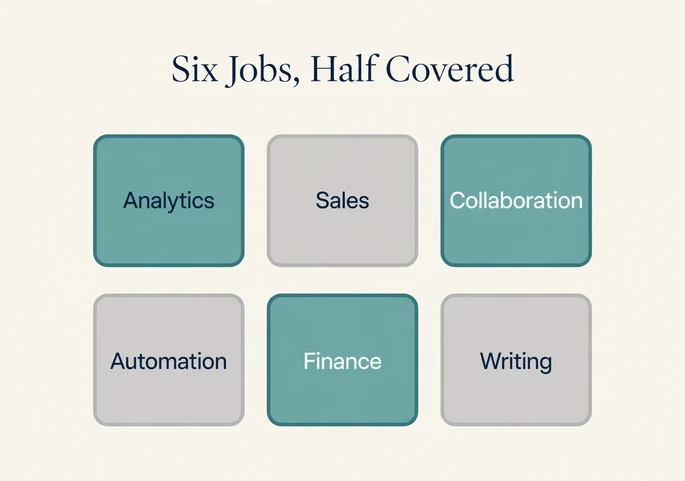
There is a gap worth noticing. The list covers writing, collaboration, and sales, but it skips analytics, finance, email, automation, and security, so it covers about half the stack a startup actually needs.
Who Is Behind Growth Navigate?
Growth Navigate describes itself as a financial and business growth partner. Its homepage lists five services: funding navigation, business advisory, investor relations, financial modeling, and startup resources. The site also runs a resources section with startup lists and finance guides.
A few details help you read it fairly:
- The homepage testimonials name three people but no companies.
- The Resources section mixes startup lists with many celebrity net worth articles, so treat the tools list as a starting page, not a tested review.
- Independent reviews report that its terms do not guarantee funding, and that it is an advisory service, not a lender.
This matters for tools too. Because the site earns its living from advisory work, its tool list is a useful starting point and not a test of the products themselves. Check each vendor’s own page before you pay.
Which Six Jobs Must a Startup Stack Cover?
Think in jobs, not brands. Each job needs one tool, and every tool should connect to a number you track.
| Job | What it does | Good starting options | Free plan or entry price (current list prices) |
|---|---|---|---|
| Analytics | Shows traffic, behavior, and retention | Google Analytics 4, Microsoft Clarity, Mixpanel | GA4 and Clarity are free; Mixpanel’s free plan reportedly covers 1 million events a month |
| Sales and CRM | Tracks leads, deals, and customers | HubSpot, Zoho CRM, Pipedrive | HubSpot has a free CRM; Starter lists near 20 dollars per seat monthly |
| Team chat | Keeps talk out of email | Slack | Free keeps 90 days of history and 10 apps; Pro is 7.25 dollars per user billed yearly or 8.75 monthly |
| Docs and tasks | Holds plans, wikis, and to dos | Notion, Trello, Asana | Notion is free for one person, Plus is about 10 dollars per member on annual billing; Trello is free with limits, while Asana Starter costs about 10.99 dollars per user monthly |
| Automation | Connects apps and removes busywork | Zapier, Make, n8n | Zapier free includes 100 tasks a month; paid plans start near 20 dollars monthly on annual billing |
| Finance | Banking, invoices, accounting, payments | Mercury, QuickBooks Online, Stripe | Mercury charges no monthly fee and is a fintech, not an FDIC insured bank; QuickBooks Simple Start is about 30 dollars a month before discounts |
Prices change often. These are current list prices, so confirm each one before you pay.
HubSpot shows why. Sources disagree on its free plan. Some say free accounts allow two users and 1,000 contacts, while others say contacts are unlimited and the real limits are on marketing emails, deal pipelines, and automation. HubSpot’s own pricing page lists a free CRM and a Starter plan near 20 dollars per seat per month, but the exact free limits depend on the product and the date, so read the vendor page, not a review, before you commit.
How Much Does a Startup Tool Stack Cost by Stage?
Build your stack in the order your business needs it, not all at once.
| Stage | Jobs to cover first | Example tools | Approximate monthly cost |
|---|---|---|---|
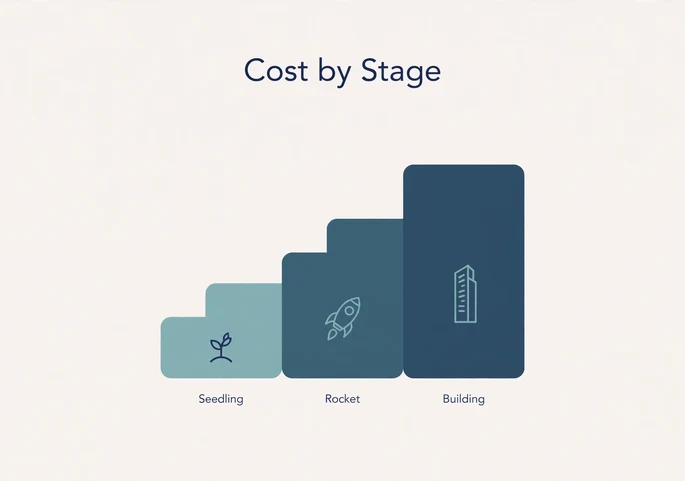
| Before first customers | Planning, analytics, a CRM, a business bank account | Notion free, GA4, HubSpot free, Mercury | 0 dollars |
| Early revenue (about 1,000 to 10,000 dollars a month) | Accounting, automation, email, shared mailbox | QuickBooks, Zapier paid plan, Google Workspace at 7 dollars per user | About 80 to 120 dollars for a small team |
| Scaling (above 10,000 dollars a month) | CRM seats, product analytics, outbound sales, team chat | HubSpot Starter seats, Mixpanel, Slack Pro | About 150 to 500 dollars, depending on headcount |
How much is too much? Rules of thumb conflict. One common guide says to keep tool spend under 5 to 8 percent of revenue, while another treats 1 percent as a ceiling for a lean team. Use the share as a check, not a rule. The better test is whether each tool saves time or wins customers that you can measure.
When Should You Move From a Free Plan to a Paid Plan?
Upgrade when one of three things is true, and not before.
- You keep hitting the limit. If you sit near the cap every month, such as Slack’s 90 days of history, 100 Zapier tasks, or the free contact limit, the upgrade buys back real work.
- A missing feature blocks revenue. Automated email sequences or deal stages that you cannot build for free are worth paying for, if they win customers.
- Your team wastes time on workarounds. Multiply the hours lost by their hourly cost and compare it with the plan price.
Do not upgrade because a competitor uses a tool, a sales rep calls you, or a feature list looks impressive. A tool that nobody opens is a cost, not a stack.
How Do You Build a Growth Navigate Startup Tools Stack Step by Step?
A growth navigate startup tools stack works best when problems pull tools in, not the other way around.
- List your three biggest problems. Leads slipping away, missed deadlines, and unclear cash are common.
- Match each problem to one job. Use the six jobs above.
- Pick one tool per job. Start with a free plan and test it for 30 days.
- Read the free limit in the vendor’s words. Check contacts, users, history, and tasks.
- Price the plan for 3 and for 10 people. Per seat prices climb faster than most founders expect.
- Read the cancellation terms before the feature list. Know how to leave.
- Export a sample of your data in week one. If you cannot export it, do not trust it.
- Connect and measure. Use native integrations or Zapier, then check that each tool saves time or improves a number you track.
How Do You Audit Your Startup Stack Every Quarter?
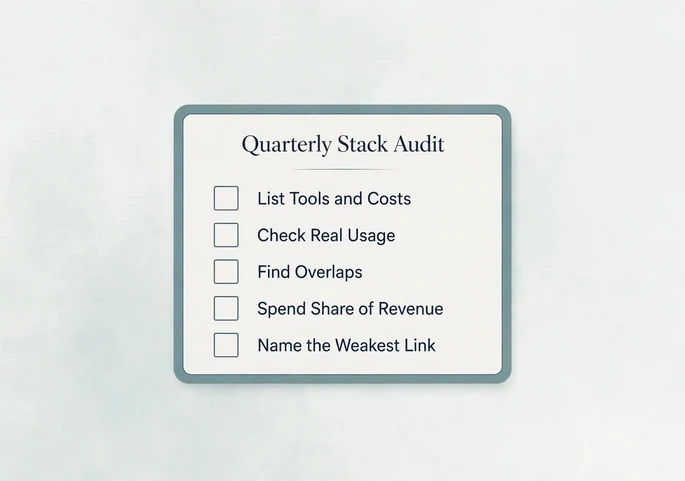
Most founders add tools and never review them. A 45 minute audit every three months fixes that.
- List every tool and its monthly cost. Divide annual plans by 12 and count every seat.
- Check real usage. If fewer than about 80 percent of the people who should use a tool log in, it is a candidate for removal.
- Look for overlap. Notion and Asana both manage tasks, Zapier and Make both automate, and HubSpot and Pipedrive both track deals.
- Calculate total spend as a share of revenue. Compare it with your own target.
- Name the weakest link. One tool is always holding you back. Upgrade it or replace it.
What Mistakes Quietly Drain a Startup’s Software Budget?
- Buying for the company you hope to be. A pre revenue team does not need an enterprise CRM.
- Paying for overlapping tools. Two apps for the same job split your data.
- Ignoring seats. Per user prices scale with every hire, including part timers.
- Automating too early. Talk to customers before you build complex workflows.
- Skipping integrations. Tools that do not connect create copy and paste work.
- Sharing one login. It breaks security and makes usage impossible to track.
- Never revisiting the stack. Tools you outgrew keep billing.
Do 90 Percent of Startups Fail?
No, that number does not match official data. U.S. Bureau of Labor Statistics figures show that roughly 20 percent of new businesses fail in their first year, about half survive five years, and about a third survive ten years. The 90 percent figure is a popular claim, not a measured rate. Some studies of venture backed startups do report higher failure rates, but they measure a narrow group, not all startups.
Where to Read More Startup Guides
If you like plain breakdowns of apps, gadgets, and company news before you spend a cent, browse our tech news, startup guides, and gadget coverage at TechWeeklys. We try to show prices, limits, and trade offs in the open, so you can judge a tool before it lands on your card.
Shortlist Software With a Second Source
When you are ready to shortlist products, our roundup of the best SaaS tools for startups gives you a second set of picks to compare with the Growth Navigate list, so you can see where two sources agree and where they do not. Test any pick on a free plan for 30 days before you commit.
Final Thoughts
Growth navigate startup tools are best treated as a method and not a shopping list. Cover the six jobs, add one tool at a time, read the real limits, and review the bill every quarter. The official Growth Navigate page is a useful starting point with twelve names, but it leaves half the jobs untouched, so build the rest from verified pricing and your own numbers.
Frequently Asked Questions
What are growth navigate startup tools?
They are software products that help a startup find customers, manage work, automate tasks, and track money, grouped by job. The phrase also points to the Startup Tools page on Growth Navigate, a website that lists twelve third party tools for writing, collaboration, and sales.
What does Growth Navigate list on its startup tools page?
The page lists Jasper, Copy.ai, Grammarly, Slack, Asana, Miro, Notion, Loom, Zoom, HubSpot Sales Hub, Zoho CRM, and Pipedrive. It shows no prices or update dates, so check each vendor’s pricing page.
How many tools does an early startup need?
Most early startups need one tool for each of about six jobs: analytics, sales, chat, tasks and docs, automation, and finance. Start on free plans and add a paid plan only when you hit a real limit.
How much does a startup tool stack cost?
A pre revenue stack can cost nothing on free plans. A small team with revenue often spends about 80 to 120 dollars a month, and larger teams about 150 to 500 dollars, depending on seats. Confirm current list prices before you buy.
Read More
Startup Booted: Meaning, Services, Fundraising and Financial Modeling
When to Outsource for SaaS Startup Growth