You search a small brand name and land on ten pages that describe ten different things. One calls it an AI startup. Another calls it a tool. A third treats it like a news site. That is exactly what happens with Droven.io, so this review starts from the live site, not from a press release. We opened the homepage, the menu, and the newest posts on November 24, 2026, and we checked what other sites say about it. The goal is simple: explain what Droven.io is, what it covers, who runs it, whether it is safe, and how to use it without being misled.
What Is Droven.io?
Droven.iois a general technology and business blog. It publishes articles under an AI and digital transformation theme, but its posts range far beyond AI. The site calls itself an editorial blog. It does not sell software, it does not ask you to log in, and it does not show a price page.
On November 24, 2026, we opened the site and went through the homepage, the menu, and the newest posts. Here is what we found at that time:
- Type of site: Editorial blog on WordPress
- Homepage title: “Droven.io | Trusted AI Info”
- Tagline: “Pioneering AI, Tech and Digital Transformation Insights”
- Login, pricing, or product page: None on the homepage
- Contact: A Contact Us page
- Legal pages: Privacy Policy and Terms and Conditions in the footer
- Social links: A Facebook page and an X handle in the page data
- Newest posts we saw: Dated November 22, 2026
The logo file on the site is dated September 2025, which suggests the site has been online since at least then. The newest posts were dated November 22, 2026, only two days before our visit, so the site was active at the time we checked it.
About Droven.io: What the Site Says About Itself
People search forabout droven.ioand “droven io about us” to learn who is behind the site. The site gives a clear mission but no clear owner.
The homepage calls itself an editorial hub and a “trusted editorial source for navigating the digital future.” It says it covers AI, technology, digital transformation, and future careers. It also says it aims to give readers useful, current information.
So the stated purpose is clear, but the people behind it are not. We found no founder name, no team page, and no About page linked from the homepage menu. The site presents itself as a publication, not as a company with a public leadership team.
Droven.io Technology Blog: What We Found on the Live Site
The menu shows how thedroven.io technology blogorganizes its content:
- AI: Artificial Intelligence, AI Tools and Applications, AI in Business and Marketing, Generative AI, and AI Tools Reviews
- Technology: Information Technology, Cybersecurity and Data Privacy, Technology News, Future Tech, Software and Apps, and Gadgets
- Digital: Digital Transformation, AI Business Processes, and Big Data and Analytics
- Reviews: Tech Reviews, AI Tools Reviews, and Productivity Tools
- Future of Work: Emerging Tech Careers and Innovation and Entrepreneurship
- Droven and Blog: General story and blog sections
That is a clear structure. The recent posts, though, spread much wider than the menu suggests. In the newest list we saw posts about:
- AI video production and AI image editing
- AI paraphrasing tools and free AI ad copy tools
- AI for small business and AI customer service agents
- AI SEO and GEO agencies and voice AI providers in the USA
- SAP data load alternatives
- Managed IT services for accounting firms and businesses in US cities
- Garage management software and gaming tools
- A deferred annuity explainer and a home alarm system guide
- Product reviews such as a budget tablet and tempered glass mousepads
Some of these fit an AI and tech blog well. Others, such as annuities and home alarms, sit far from the site’s stated focus. That gap matters because readers who come for AI advice may land on unrelated product content.
Is Droven.io an AI Startup, Software, or a Tool?
Searches fordroven.io ai startupare common, and the answer is no, based on what we saw. A startup builds a product or a service. Droven.io builds articles. It does not offer a product, a demo, or an account. It is a content site.
The same applies todroven io ai automation tools. Some third party articles describe Droven.io as a platform or a tool. On the live site we saw no tool to use, no download, and no automation product. The word “tools” in those articles usually refers to the tools Droven.io writes about, not to a tool it sells.
The accurate label is “editorial website that writes about AI and technology.” The tools discussed in its articles are made by other companies. That distinction is important when you judge whether its advice is independent.
Droven.io USA: Is It an American Website?
Readers also searchdroven.io usa. The site is written in English and many posts target US readers. Examples include posts on voice AI providers in the USA, managed IT services in US cities, and AI SEO agencies in the USA. The site also covers US tech market news.
Still, that tells us who the content is aimed at, not who owns the site. One independent summary calls it a US based blog, but we could not confirm the owner’s country from the site itself. There is no address, no company registration, and no team page on the homepage. So the safest statement is: it is an English language blog with a strong US reader focus, and its ownership is not public.
Who Runs Droven.io? What We Could and Could Not Verify
Confirmed from the site:
- It is an active WordPress blog with fresh posts
- It has a working contact page, a privacy policy, and terms
- It has no sign of a product, subscription, or login
Not confirmed:
- Who owns or edits the site
- Who writes each post, since we saw no clear bylines on the homepage
- Whether any posts are paid or sponsored
- Its traffic or audience size
Spelling Variations and Lookalike Sites
You will see the name written many ways:droven .iowith a space, “droven. io” with a gap after the dot, “droven io” without a dot, and “drovenio” with no dot at all. Search engines usually treat these as the same name, but lookalike domains are a real risk.
Other sites use similar names, such as drovenio.com, droven-io.com, and droven-io.blog. We could not verify who owns those domains. If you are looking for the blog, type droven.io yourself. Do not trust a lookalike link in an email or an ad.
Droven.io Reviews: What Others Say and What We Saw
Mostdroven.io reviewsonline agree on a few things. They call it a free educational site, say it explains AI in plain language, and say it covers AI tools, business automation, and tech news.
Where we differ is the scope. Many reviews describe a focused AI learning hub. The live site looks much wider and much more commercial in places. The newest posts include many articles that focus on one named product or service, such as a named software tool, a named agency, or a named financial product.
This pattern is common on sites that accept guest posts or promotional content. The homepage does not label posts as sponsored, and we could not confirm whether any were paid. That does not prove they are paid, but it means readers should be careful with posts that read like a sales page.
We also noticed one article, “Transforming Legacy IT: A Complete Guide to Modern Cloud Infrastructure,” had a byline naming “Team Droven” as the author and included an image. That was one of the few author signals we saw.
Strengths:
- Many posts are dated within the same week
- Very wide topic range
- Clear menu sections
- No paywall or login on the pages we saw
Weaknesses:
- Posts range from AI tools to annuities and alarms
- Many posts center on one named product or service
- No clear bylines or team page on the homepage
- No About page and no sponsored labels
Droven.io AI Technology: The Basics Behind the Tools
People searchingdroven.io ai technologyusually want a plain explanation of what is under the hood. Most AI tools rest on four building blocks:
- Machine learning learns patterns from data and predicts outcomes, such as flagging a likely fraud payment or sorting support tickets.
- Natural language processing reads, writes, and summarizes human language, such as sorting customer emails or drafting a reply.
- Computer vision reads images and video, such as checking product quality on a line.
- Generative AI creates new text, images, audio, or code from a prompt.
Nearly all AI in use today is “limited memory” AI. It learns from past data to improve decisions. Ideas such as general intelligence and self aware machines exist in research, but they are not what a business buys today.
On top of these sits agentic AI. An agent does not only answer. It plans steps and takes actions across systems, such as pulling data, drafting a message, and filing a ticket. Agents are useful, but they also need clear limits, because they act on your behalf.
Droven.io AI Tools 2026: The Four Types You Will Meet
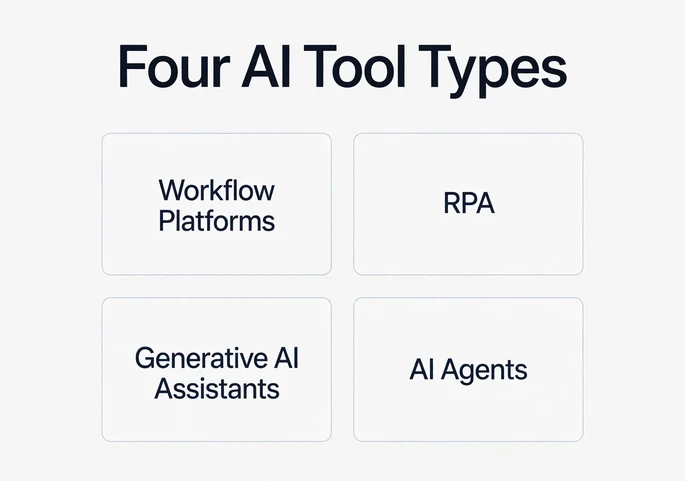
Searches fordroven.io ai tools 2026show that readers want a map of the tool landscape. Droven.io does not sell tools, but its articles describe four main types:
- No code and low code workflow platforms.These connect your apps using triggers and actions. Zapier, Make, and n8n are common examples. They are best for predictable, repeatable steps.
- Robotic process automation (RPA).These tools copy human actions on a screen. They shine when an older system has no modern connection point. UiPath and Automation Anywhere are well known names here.
- Generative AI assistants.These draft text, summarize documents, write code, and answer questions. Anthropic’s Claude, OpenAI’s ChatGPT, Google Gemini, and Microsoft Copilot are the main names.
- AI agents.These plan and complete multiple step tasks across several systems. They are powerful and need careful access controls and human checks.
A simple rule works well. Use workflow tools for predictable steps, RPA for older systems, generative AI for drafts and summaries, and agents only when you can supervise them.
Droven io AI Automation Tools: How to Choose One
Whether you found an idea on Droven.io or anywhere else, these seven questions help you choose a tool:
- What exact task do you want to automate, and how often does it happen?
- Where does the data live, and is it clean enough to use?
- Does the tool connect to your CRM, accounting system, email, and database?
- What security controls does it offer, such as permissions, encryption, and audit logs?
- Who approves important actions, and can a person step in?
- What is the total cost, including setup, usage fees, support, and maintenance?
- How will you measure success, and what is your baseline today?
Also decide whether to build or buy. Buying a ready platform is faster and cheaper for common tasks. Building your own makes sense only when no ready tool fits your process.
Droven.io AI for Business: Where Automation Pays Off
Searches fordroven.io ai for businessanddrovenio ai for businessshow that owners want practical advice, not theory. Automation pays off first in repeatable work:
- Sales and CRM:Capture leads, clean contact data, assign them to the right rep, summarize calls, and draft follow ups.
- Marketing:Connect forms, ad platforms, email tools, and a CRM. AI can sort inquiries and draft first replies.
- Customer service:Tag and route tickets, suggest answers from an approved knowledge base, and write summaries after each case.
- Finance and admin:Pull data from invoices, route approvals, send payment reminders, and flag odd transactions.
- Human resources:Automate onboarding forms, training reminders, and routine employee requests.
- IT and operations:Reset passwords, monitor systems, and open tickets when something breaks.
A good first project is small and boring. Invoice data entry, lead routing, and ticket sorting beat a large, flashy project every time. They are easy to measure, easy to fix, and easy to explain to staff.
Droven.io RPA and Business Automation Explained
The phrasedroven.io rpa and business automationpoints to a topic that confuses many beginners, because three different ideas sound alike:
- RPA copies clicks and keystrokes in a screen. It is best when an older system has no connection point.
- Workflow automation connects apps through APIs and rules. It is best when your modern apps can already talk to each other.
- AI automation and agents read text, classify data, draft replies, and decide next steps. They are best when the work needs judgment, not just repetition.
The strongest setups combine all three. Here is a simple example. A company receives supplier invoices by email. Workflow automation pulls the attachment into the system. AI reads the invoice and checks it against the order. RPA enters the approved data into an old accounting system that has no modern connection. A human approves the payment.
This end to end combination is often called hyperautomation. Coworker AI cites forecasts that hyperautomation spending may reach $55.5 billion by 2030. That is a forecast, not a fact, but it shows why vendors push combined systems.
What the 2026 Data Says About AI Automation
Sources count things differently, so treat these as signals.
- About 60% of businesses have automated at least one workflow, according to figures attributed to Duke University’s Fuqua School of Business.
- The workflow automation market is valued at about $26 billion to $27.9 billion in 2026, based on Mordor Intelligence and Grand View Research.
- The global RPA market is estimated at $35.27 billion in 2026 by Precedence Research.
- Measured AI adoption ranges from about 18% to 88%, depending on who is counted.
- A 2026 CIO survey cited by Gartner found that about 17% of organizations had deployed AI agents, and 46% had piloted or built them.
The most useful number comes from McKinsey survey data reported in August 2026. Only 37% of respondents said their organizations had embedded AI into at least one business function. The rest were still in pilots or plans. That gap explains why many projects feel stuck: the tool is bought, but the work has not changed.
Why AI Automation Projects Stall
Projects rarely fail because the technology is weak. They stall for five human reasons.
- They start with the tool instead of the process.A team buys a platform and then hunts for something to automate.
- Nobody owns the result.IT, legal, security, and business teams all play a part, so no one signs off.
- The data is messy.Duplicate records, old files, and loose permissions make AI results unreliable.
- Staff use unapproved tools.Microsoft’s 2024 Work Trend Index found that 78% of AI users bring their own tools to work.
- Nobody measures value.Counting licenses or prompts is not the same as measuring hours saved or errors avoided.
The governance gap is real. IBM and Oxford Economics reported in 2026 that 77% of senior executives say AI governance keeps them up at night, up from 56% a year earlier. This is why a small pilot with clear ownership beats a large rollout with no owner.
Droven io AI Automation in USA: What American Businesses Should Know
Interest indroven io ai automation in usashows that American readers want local context. No single tool fits every business, and US rules add another layer.
A small professional services firm may only need a CRM and email workflow. A larger company may need connected systems, data governance, and vendor management. The right choice depends on size, industry, and data, not on a “best tool” list.
Three US points are worth knowing:
- The NIST AI Risk Management Framework is a voluntary guide from the US National Institute of Standards and Technology. It helps teams map risks, measure them, and manage them.
- Privacy laws differ by state, and some industries, such as healthcare and finance, carry extra duties.
- One 2026 summary reports that small business AI use rose from 22% in 2024 to 38% in 2026. This comes from a survey of 1,600 business leaders cited by a small business AI firm.
If an article ranks “best AI automation providers in the USA,” ask who wrote it and whether the provider paid for placement. Droven.io does not label sponsored posts on its homepage, so readers should check that point themselves.
Drovenio AI in Digital Transformation
The phrasedrovenio ai in digital transformationmatters because many companies treat AI as a shopping list. They buy tools and hope the business changes. Digital transformation is the opposite order: change the process first, then choose the tool.
Answer these seven questions before choosing any tool:
- Which process should change?
- Where does the source data live?
- Who owns the process?
- Which decisions can be automated?
- Which decisions need human approval?
- How will errors be caught?
- What result will prove the value?
A Simple 90 Day Plan
Days 1 to 30: Choose and map.Pick one process that is frequent, rule based, and measurable. Write down each step, who does it, and what data it needs.
Days 31 to 60: Build a small pilot.Choose the tool type that fits the job. Use a limited set of real data. Train the people who will use it.
Days 61 to 90: Test and decide.Test missing data, duplicates, system failures, and strange requests. Measure time saved and errors avoided. If the pilot works, expand it. If not, stop and learn.

Droven io Artificial Intelligence News: What Matters in 2026
The most useful way to readdroven io artificial intelligence newsis to look past headlines and watch the shifts that change how work is done:
From generative AI to agentic AI.Generative AI creates text and images. Agentic AI goes further by planning and taking actions across systems. That shift raises new questions about access, logging, and approval.
Better hardware.New chips, memory systems, and networking are speeding up training and cutting the cost of running models. That matters because cheaper models make AI useful in smaller businesses.
AI inside security teams.Defenders use AI to detect odd behavior and respond faster. Attackers use it to build better phishing and exploits. Both sides are using the same tools.
Governance gets real.The EU delayed some AI Act deadlines through a law called the Digital Omnibus on December 4, 2025. The EU also published a plan for the Digital Decade on November 19, 2025. In the US, NIST’s voluntary framework is the main guide. Companies that sell into Europe need to track both.
Risks Every Reader Should Know
- Bias: Weak or incomplete data creates unfair results
- Security threats: AI helps attackers build better phishing and exploits
- Privacy: AI often depends on large data sets, so privacy controls matter
- Job changes: Routine tasks shrink while oversight and technical roles grow
- Lack of accountability: Someone must own the outcome when AI makes a bad call
Droven.io Machine Learning Trends
Interest indroven.io machine learning trendsreflects how fast the field changes. Six trends stand out:
- Agents over chatbots.Models that plan and use tools are replacing single answer assistants.
- Multimodal models.One system can handle text, images, audio, and video together.
- Smaller, cheaper models.Companies increasingly pick compact models for narrow jobs instead of the largest model for everything.
- Machine learning in operations.Teams invest in monitoring, testing, and retraining so models keep working after launch.
- Responsible AI.Fairness checks, documentation, and audit trails are becoming normal parts of any project.
- Industry specific use.Healthcare, finance, retail, and logistics are building focused models on their own data.
One caution applies to all six. Adoption numbers vary widely by survey, so always check how a statistic was counted before you quote it.
Droven io Cybersecurity Updates
The searchdroven io cybersecurity updatesreflects a worry many leaders share: AI is changing both attack and defense. Here is what 2026 reports say:
- CrowdStrike’s 2026 Global Threat Report recorded an 89% increase in attacks attributed to AI enabled cybercrime, according to Cyber Security News.
- IBM’s 2026 Cost of a Data Breach Report, published July 29, 2026, found that one in four malicious data breaches was driven by AI, according to The CFO.
- Check Point Research’s AI Security Report 2026, released July 14, says AI now helps run attacks, not just write phishing emails.
- An IRONSCALES survey of 501 US security professionals found that 77% of organizations had agentic AI email attacks in the past year, and that 68% say agentic AI attacks are now the top email threat.
- A Kiteworks summary of a 2026 survey found 46% of security professionals say they are not adequately prepared for AI driven attacks.
- On May 1, 2026, six national cybersecurity agencies, including the US CISA and NSA, published joint guidance on the secure deployment of AI systems.
What to Do About It
- Know every AI agent you run and what each can access
- Give agents only the access they need, and log every action
- Treat email as an entry point, since attackers target agents through messages
- Scan code and dependencies for known weaknesses and leaked secrets
- Keep a human approval step for actions that move money, delete data, or change permissions
- Test your defenses against prompt injection and data leaks
Droven.io USA Tech Market Updates and Tech Updates
Readers who searchdroven.io usa tech market updatesanddroven.io usa tech updateswant a quick picture of the market. Four points stand out for 2026:
- Spending is at record levels.Forrester forecasts US technology spending at about $2.9 trillion in 2026, up 5.6% from 2025, according to CIODIVE.
- Big Tech is spending on data centers at unusual speed.Forecasts for combined 2026 capital spending by Amazon, Alphabet, Microsoft, and Meta range from $350 billion to $430 billion.
- Investors are asking hard questions.Several analysts note that hyperscalers lean more on debt to fund AI data centers, and some warn about overcapacity.
- Energy and chips shape the pace.Power supply and memory chip prices limit how fast new capacity can be built.
For a business owner, this means cloud and AI services will likely stay available and competitive, but prices may rise where energy and chips are tight.
Droven.io Best AI Startups in USA
Many readers searchdroven.io best ai startups in usa. Droven.io is a content site, so this section uses public startup lists and funding data to explain the landscape. It is not a ranking from Droven.io itself.
- Frontier model labs: OpenAI, Anthropic, xAI
- Data and infrastructure: Databricks, Scale AI, Fireworks AI, Together AI
- AI coding: Cursor (Anysphere), Cognition
- Industry specific AI: Harvey for legal, Decagon and Sierra for customer support
- Robotics and physical AI: Figure AI, Skild AI, Waymo
- Search and developer tools: Perplexity, LangChain
A few funding points from independent trackers:
- OpenAI reportedly closed an $11 billion round at a $1.25 trillion valuation in early November 2026, according to The Wall Street Journal.
- Value Add VC tracked 112 AI venture rounds in 2026 totaling about $281.1 billion at its latest update.
- Recent large rounds include Fireworks AI at $1.5 billion in July 2026, Cognition at $2 billion in September 2026, and Luma AI at $2.24 billion in October 2026.
Money is concentrating on infrastructure, coding tools, and agents. If you are a founder, investors are asking for real revenue, not just a demo. If you are a buyer, the safest bet is a tool with a clear use case and a vendor that can support it.
Droven io Future of AI and Future Technology USA
The searchesdroven io future of aianddroven io future technology usaask where all this leads. Nobody can predict the future with certainty, but six directions are clear:
- More autonomous agents doing multiple step work inside business systems
- AI inside daily tools like email, spreadsheets, and customer support
- Faster, cheaper hardware that lowers the cost of running models
- AI in security on both sides of the fight
- Stricter governance and audit rules, including the EU AI Act timeline for any company serving Europe
- New jobs around AI, such as engineers, data specialists, and people who oversee and test AI systems
The United States leads in AI investment, but the market is turning more global. Infrastructure, chips, and energy will shape who can build and run the next wave.
Droven.io Best Tech Tools for Developers
Developers searchdroven.io best tech tools for developers,droven io best tech tools for developers, anddroven.io best tech toolsfor a short list they can trust. The answer depends on the job, but the 2026 data shows what most developers actually use.
The Stack Overflow Developer Survey 2026, released on October 6, 2026, shows what developers use:
- JavaScript is the most used language for the twelfth year at 62%, followed by SQL (58.4%), HTML and CSS (53%), Python (51%), TypeScript (43%), and Bash/Shell (31%).
- Visual Studio Code is the most used editor at 70.9%, ahead of Notepad++ (27.8%), Visual Studio (27.6%), IntelliJ IDEA (27%), and Vim (22.4%).
- PostgreSQL leads databases at 58%, ahead of SQLite (42%), MySQL (35%), and Redis (28%).
A balanced toolkit covers nine jobs:
- Code editors and IDEs:Visual Studio Code, JetBrains IDEs, Vim or Neovim
- Version control:Git with GitHub, GitLab, or Bitbucket. Keep branches short, review every pull request, and never push secrets.
- API tools:Postman for testing and the OpenAPI standard for documentation
- Databases:PostgreSQL, SQLite, MySQL, and Redis, with tested backups and separate development and production data
- Testing and quality:pytest, JUnit, Jest, Playwright or Cypress, plus linters and formatters, running in CI
- Containers, cloud, and deployment:Docker, Kubernetes, Terraform, and CI tools such as GitHub Actions
- Monitoring:logs, metrics, and an error tracker such as Sentry
- Security:dependency scanners, secret scanners, least privilege access, and two factor login
- Automation:scripts, task runners, and workflow tools such as n8n
Use seven questions to choose any new tool: what problem it solves, whether it fits your stack, how often you will use it, what it costs over a year, how well it is maintained, how easy it is to leave, and whether your team will actually use it.
AI Coding Assistants: What the 2026 Data Says
- 83% of developers use at least one AI tool. About 66% use coding assistants or agents, 62.5% use generative search, and 43.5% use AI tools for testing code.
- Among coding assistants and agents, Claude Code was selected by 65.5% of that question’s respondents, followed by ChatGPT at 50%, GitHub Copilot at 48%, Cursor at 29%, Gemini Code Assist at 18%, and Cline at 17%.
- Trust is conditional. 48% trust AI output when they can easily verify it, and only 6.6% trust it for complex problems.
- Most developers check AI output by running it locally (76%), comparing it with their codebase (64%), reading it carefully (64%), and testing in a sandbox (33%).
- Only 24% say their organization has approved tools or an official AI policy.
- A 2023 study from Microsoft Research, GitHub, and MIT found developers finished a task about 56% faster with GitHub Copilot.
Use AI for easy to check tasks like test drafts and boilerplate, never merge code you cannot explain, and keep a human review step for anything that touches data or money.
Droven. io Software Development Tips
Readers who searchdroven. io software development tipswant habits that work, not another tool. These twelve habits help most:
- Start with the problem. Write it in one sentence before you open an editor.
- Make small changes. Small pull requests are easier to review and safer to ship.
- Write a test for every bug you fix.
- Name things clearly. Good names save more time than clever code.
- Read error messages fully. The answer is often in the last two lines.
- Search before you ask. Online search is the first stop for 82.7% of developers in the 2026 survey.
- Keep documentation close to the code, and keep it current.
- Automate what you do twice. The third time, write a script.
- Review your own pull request first.
- Never commit secrets. Use environment variables or a secrets manager.
- Take breaks. Fresh eyes find bugs faster than tired ones.
- Delete code you do not need.
Droven.io AI Career Roadmap
People who searchdroven.io ai career roadmapwant a clear path, not buzzwords. Droven.io has a Future of Work section with a career focus, but it does not publish a detailed roadmap of its own. The plan below uses public job market data and common hiring patterns.
What the Job Market Data Says
The US Bureau of Labor Statistics reports:
- Software developers, quality assurance analysts, and testers held about 1.9 million jobs in 2024, and 1.3 million of those were software developers.
- The median annual wage for software developers was $133,080 in May 2024, and $102,610 for quality assurance analysts and testers.
- Computer occupations had a median wage of $105,990, compared with $49,500 for all occupations.
- Web developers had a median wage of $90,930, with employment projected to grow 7%.
- Employment of computer programmers is projected to decline 6%.
Work that is only about typing code is shrinking, while work that mixes problem solving, design, testing, and AI use is growing. That is why the roadmap below mixes coding, testing, and shipping.
A 12 Month Roadmap
Months 1 to 3: Build the base.Learn one language well, such as Python or JavaScript. Learn Git and put every project in a repository. Learn the basics of testing.
Months 4 to 6: Add practical skills.Learn how APIs work and build one. Learn testing. Learn the basics of databases and SQL.
Months 7 to 9: Learn to ship.Learn Docker and deploy a small app. Set up a continuous integration pipeline. Learn to read logs and fix live bugs.
Months 10 to 12: Specialize and prove it.Pick a path: AI automation, data analysis, machine learning, cybersecurity, or web development. Build two projects that show real work. Share them on GitHub and write a short post about what you learned.
Roles this path can lead to include junior software developer, AI automation specialist, data analyst, QA engineer, DevOps assistant, and cybersecurity analyst.
Is Droven.io Safe, Legit, and Free?
Based on our visit, Droven.io behaves like a normal publishing site. It loaded without errors, has a contact page, privacy policy, and terms, and posts new articles regularly. It does not ask for a login, a card, or a subscription on the pages we visited.
Safe has two meanings here. Reading the site carries the usual small risks of any website. Trusting its advice without checking is the bigger risk, because the site has no named authors and no sponsored labels on its homepage. Use these rules:
- Type the address yourself instead of following a lookalike link
- Do not enter passwords or card details on any page that claims to be Droven
- Read vendor focused posts with the company’s own pricing and terms open in another tab
How Droven.io Compares With Other Sources
- Droven.io: Free, frequent, and wide in range, but mixed in focus and unclear on authors. Best for quick overviews.
- AI chatbots: Fast answers to specific questions, but they can be confidently wrong. Best for follow up questions after you have read a source.
- Vendor blogs: Deep detail on one product, but written to sell. Best for checking one tool’s features.
- Official documentation: Most accurate for a given tool, but dry and technical. Best for setup and troubleshooting.
- Independent tech news sites: Named authors and reporting, but sometimes paywalled. Best for news and analysis.
Who Should Use Droven.io
Good fit:
- Readers who want a quick overview of an AI tool or business topic
- Small business owners looking for ideas to explore further
- Students and beginners who want plain language explanations
Poor fit:
- Buyers who need neutral comparisons between competing products
- Researchers who need named authors and cited sources
- Anyone who wants a software tool to run workflows
How to Read Any Tech Article Wisely
- Check the date. AI and software change fast, so older posts may be out of date.
- Look for a named author. If there is none, treat the post as general guidance.
- Spot the vendor. If the whole article praises one company, balance it with independent reviews.
- Verify every number. Confirm prices, statistics, and claims at their source.
- Use it as a starting point. Read the overview, then go to official pages before you decide.
What We Could Not Verify
We checked the Droven.io homepage, the menu, and the recent post list. We did not read every article on the site. We could not confirm who owns the site, who writes each post, whether any posts are paid, or how large its audience is. Those limits apply to this review as well.
Final Thoughts
Droven.io covers topics that many readers care about, from AI tools and business automation to cybersecurity, startups, and careers. It is free, active, and easy to read. Its main weakness is focus: the newest posts range from AI tools to annuities and alarms, and the site gives no clear author or sponsorship signals.
Before you act on any post, check who wrote it, when it was published, and whether the article is really about the topic you need. If you use Droven.io that way, it can help you find ideas and learn new terms.
Droven.ioworks best as a place to find ideas, not as a place to find final answers. Read it with a critical eye, check the numbers at their source, and use official pages before you spend money or change a system.
Frequently Asked Questions
What is Droven.io?
Droven.iois a free editorial blog that publishes articles about AI, technology, digital transformation, and future careers. It does not sell software or ask for a login.
Is it legit and safe?
It appears legitimate. It has a contact page, a privacy policy, terms, and regular new posts. Check the address yourself, do not enter passwords or card details on any page that claims to be Droven, and treat vendor focused posts with care.
Does Droven sell software or AI tools?
No evidence on the site shows that it does. The homepage has no product, pricing, or login. Articles describe tools made by other companies.
Is it free to use?
Yes, as far as we could see. We found no paywall, subscription, or login on the pages we visited.
Read More