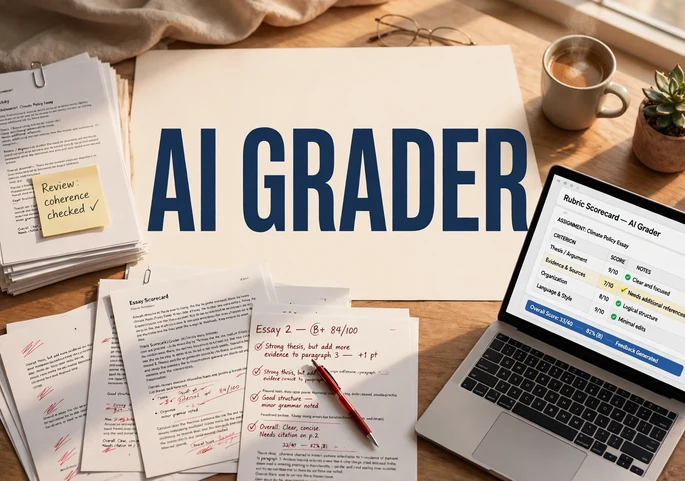
Waiting days for feedback on a draft is painful. What if software could score your essay in a few seconds? An ai grader can read a paper, score it against a rubric, and explain what to fix, and this guide covers how it works for students and teachers, what it checks, where it falls short, and how to use it honestly.
What Is an AI Grader?
An ai grader is software that reads writing and scores it against a set of criteria. It usually gives a numeric or letter score plus written comments. Some tools are built for students who want to check a draft before they submit it. Others are built for teachers who need to mark many papers quickly.
How Students Use an AI Grader
Students usually paste text or upload a file, and an essay grader ai tool returns rubric scores and written feedback. Many tools let you predict your likely grade before you hand the paper in. Some vendors say they offer free tiers with limits, such as one free grade per day. Plans and limits change often, so check each tool’s current terms before you rely on it.
How Teachers Use an AI Grading Tool
Teachers use an ai grading tool to save time on large piles of papers. Some tools claim they can take a whole class PDF at once, and some say they can read handwritten work. The teacher sets the rubric, and the software applies it to each paper. The safest setups let the teacher review and approve every score before anything reaches a student, and many also produce class reports.
Common Rubric Areas an AI Essay Grader Checks
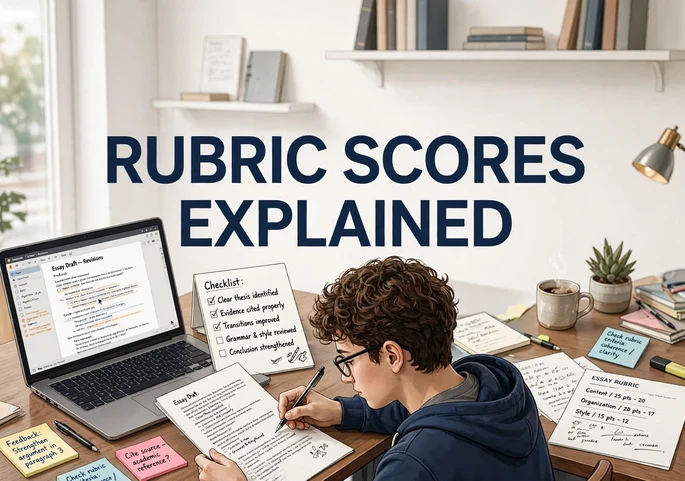
Most tools score the same core areas, even when they use different names for them. A good ai essay grader shows a separate score for each area, so you can see exactly where a paper lost points. A single overall number hides too much. These are the usual areas:
- Thesis or claim: is the main point clear and arguable?
- Evidence: do the examples and sources support the claim?
- Organization: do the ideas follow a logical order?
- Grammar and mechanics: are spelling, punctuation, and sentence form correct?
- Style and clarity: is the writing easy to follow and suited to the reader?
AI Grader vs AI Detector
A grader judges quality against criteria. A detector estimates whether text looks like it was written by AI. These tools answer two different questions. A high grade says nothing about who wrote the essay, and a detector result says nothing about how good the essay is. Do not mix up an AI grader with a detector, because each one needs its own careful reading.
Ethics and School Rules
Always follow your school or course policy on AI tools. Some classes allow AI feedback, and some do not, so ask your teacher if the policy is unclear. Write the essay yourself, and treat the tool as a coaching aid. A score from an ai grader is advice, and it is never the teacher’s final grade.
Limits to Know Before You Rely on It
These tools have real limits. Scores can shift after you revise the same paper, which shows that results are not perfectly stable. Long papers may be cut off, so the tool may not read your full essay. Free plans also cap usage, and vendor accuracy claims are claims, not proof. We have not tested any specific tool for this article, so treat feature lists as vendor statements.
AI Tools for Startups and Teams
AI tools now help small teams with writing, support, and review tasks as well as school work. They save time when the task is repeatable and a human can check the result. The same idea applies to grading, where software drafts the score and a person approves it. Teams that grow fast need to decide which tasks software or outside help can take over.
Startups deciding what work to keep in house can start with our guide on SaaS startup outsourcing.
More AI Academic Tools Students Need
Good essays need more than a score. They also need sources that are credited correctly. Students often use several AI tools in one project, from feedback tools to reference helpers. Each tool should support your own work and never replace it.
If you cite sources, an AI citation generator is another AI academic tool worth knowing.
Conclusion
An ai grader gives fast, rubric based feedback, and that can help students improve a draft and help teachers move faster. It works best as a second opinion, not a judge. Keep a human in charge of the final grade, follow your school’s AI rules, and check each tool’s current limits and pricing. Use the feedback, then do the revising yourself.
Frequently Asked Questions
Is an AI grader accurate?
Accuracy varies by tool, and vendors make their own claims about it. Scores can change when you revise or resubmit a paper. Treat any ai grader result as a guide, and ask a teacher for a final judgment.
Can an AI grader replace a teacher?
No. These tools score against a rubric, but they cannot fully understand context, effort, or classroom goals. The best setups keep the teacher in charge of approving every score.
Is an AI grader the same as an AI detector?
No. A grader scores quality against criteria. A detector guesses whether text looks AI generated, and the two results should never be mixed up.
Are free AI essay graders available?
Some tools say they offer free tiers, often with limits such as one free grade per day. Limits and prices change, so check the tool’s own page before you start.
Read More
Keep exploring more Tech Weeklys guides: