Most people answer this question wrong, and the mistake costs them marks on AI exams and bad tool choices at work. The confusion is understandable, because generative AI and predictive AI sound like close cousins until you see what each one actually does. One creates, the other predicts, and mixing them up is the most common error beginners make. So how do you tell a real generative task apart from a fake one in seconds?
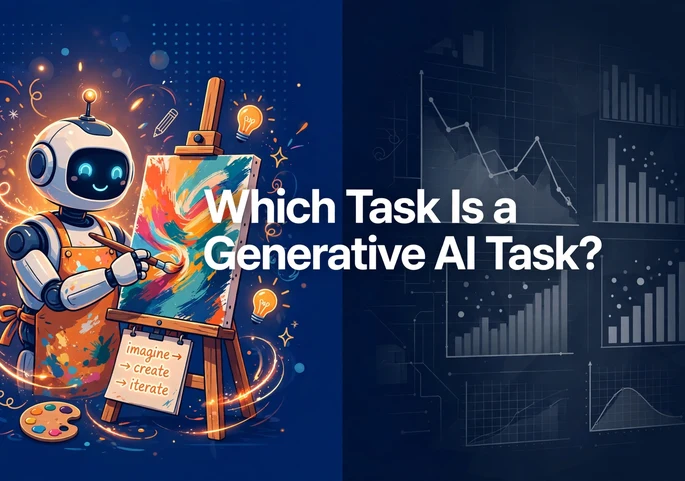
Here is the short answer. A generative AI task is any task where the goal is to create new content that did not exist before: text, images, music, video, or code. If the job is to predict what happens next, classify data, or spot fraud, it belongs to predictive AI, a different branch with different strengths. Keep that distinction in mind, because everything in this guide builds on it.
This guide gives you 10 everyday examples, a 12 row classification table, a head to head comparison, a 5 question self test, and fresh 2026 adoption data. You will also learn why this exact question appears on AI certification exams and when you should never trust a chatbot alone. The 10 second test in the middle is the part you will use for the rest of your career, so keep reading.
What Makes a Task a Generative AI Task?
Three traits mark every generative AI task, and checking them takes only seconds. First, the input is a prompt, which means you describe what you want in plain words instead of feeding the system labeled data. Second, the output is genuinely new: original text, images, audio, or video that did not exist before you asked. Third, the engine behind it is a foundation model, a large neural network trained on massive amounts of data so it can remix learned patterns into fresh content.
Which Tools Handle Generative AI Tasks?
The most familiar tools run on large language models, which specialize in text. ChatGPT, Claude, and Gemini all belong in this group, and they draft, summarize, translate, and converse every day. Image generation runs on a different architecture called diffusion models, where DALL-E 3 and Midjourney lead the field. For code, GitHub Copilot sits inside your editor and writes functions from plain descriptions, while video tools like Sora turn text prompts into short clips.
How Does a Generative AI Task Actually Work?
Under the hood, the model predicts the next token, a small chunk of text or pixels, over and over until the content is complete. It learned those patterns during training, when it studied billions of examples of writing, images, or code. At generation time there is no database lookup and no fixed answer, only probabilities guiding each next chunk. That is why these tools are brilliant at creating fresh content and unreliable at calculating exact figures.
What Is the 10 Second Test?
Ask one question: does the task end with something newly created, or with a prediction about something? A new email, image, song, or code snippet means a generative AI task, because the output did not exist before you asked. A number, a yes or no label, or a ranked list means a predictive task, because the answer is derived from existing data. That single question answers most exam questions and most real tool choices correctly, and the table below lets you practice it until it becomes instinct.
10 Clear Examples of Generative AI Tasks
These are the tasks generative AI handles best in 2026, drawn from real tools that millions of people use every day. Each one follows the same pattern: a prompt goes in, and something newly made comes out. Read through them and notice how every example ends with fresh content rather than a prediction. If you can spot that pattern here, you will be able to spot it anywhere, on an exam or at work.
- Writing text. Drafting emails, articles, stories, product descriptions, and marketing copy. ChatGPT and Claude lead here.
- Creating images. Generating artwork, logos, and product mockups from a text prompt. DALL-E 3 and Midjourney are the popular picks.
- Writing code. Producing new functions, scripts, and boilerplate from a plain description. GitHub Copilot does this inside your editor.
- Composing music. Creating original songs and soundtracks in a chosen style.
- Translating documents. Producing new text in the target language. Translation counts as generative because the output is newly written text, not a predicted number.
- Summarizing long documents. Condensing a 50 page report into key points. The summary is new content, so this is a generative AI task.
- Holding conversations. Chatbots and virtual assistants that reply in natural back and forth dialogue.
- Designing presentations. Turning bullet points into full slide decks with titles and talking points.
- Creating video. Generating short clips and animations from a text description. Tools like Sora do this in 2026.
- Brainstorming ideas. Producing lists of names, angles, and concepts that did not exist before.
Which Tasks Are NOT Generative AI Tasks?
These tasks belong to predictive or traditional AI, and they fail the 10 second test every single time. Each one starts with historical data and ends with a forecast, a label, or a ranking, so nothing new gets created in the process. Learning this side matters just as much as the generative side, because exam questions love to mix the two and watch you slip. Study both lists together and the boundary between them becomes obvious.
- Forecasting. Predicting sales, demand, or stock movement from past data.
- Classification. Sorting emails as spam or not spam. Labeling support tickets by topic.
- Fraud detection. Flagging suspicious credit card transactions based on patterns.
- Recommendations. Suggesting the next video, product, or song from your history.
- Optimization. Planning delivery routes or managing inventory levels.
Each one ends with a prediction, a label, or a ranking, so nothing new gets created. For the full safety checklist on picking the right jobs for these tools, see our guide on what would be an appropriate task for using generative AI.
Generative AI vs Predictive AI: The Full Comparison
| Generative AI tasks | Predictive AI tasks | |
|---|---|---|
| Goal | Create new content | Forecast an outcome |
| Output | Original text, images, music, code | Probabilities, predictions, labels |
| Input | A prompt in plain words | Historical, labeled data |
| Examples | Write a song, design a logo, draft an email | Predict churn, forecast sales, detect fraud |
| Best for | Creativity and content production | Planning and decision support |
| 2026 tools | ChatGPT, Claude, Gemini, Midjourney | Classic machine learning platforms |
A quick way to remember the difference: generative AI is the artist, predictive AI is the fortune teller. One makes things, the other guesses what comes next. The artist needs a blank canvas and a prompt, while the fortune teller needs historical data and a question about the future. Pick the wrong one and you get confident nonsense, like asking a chatbot to forecast next quarter’s revenue.
For a deeper look at the predictive side, see this clear explainer on generative AI vs predictive AI from eWeek. It covers how forecasting models train on labeled data and where they beat generative tools. Reading both guides gives you the complete picture of modern AI. You will know exactly which tool to reach for in any situation.
The 10 Second Test: Classify Any Task Yourself
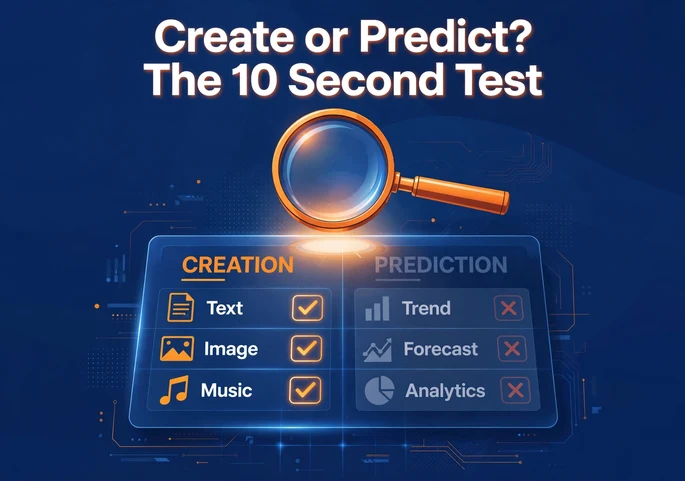
Run each task through the one question and decide before you peek at the answers. Does it create or predict? Cover the right column with your hand and test yourself honestly on every row. Each example below follows the same rule you just learned, so there are no trick questions waiting for you. When you can classify all twelve without hesitation, the concept is locked in for good.
| Task | Generative AI task? | Why |
|---|---|---|
| Writing a birthday song | Yes | Creates new music and lyrics |
| Predicting which customers will cancel | No | Forecasts an outcome from past data |
| Generating a logo from a text prompt | Yes | Creates a new image |
| Detecting fraudulent transactions | No | Classifies activity as fraud or not |
| Translating a contract into another language | Yes | Produces new text in the target language |
| Forecasting next quarter sales | No | Predicts a number |
| Summarizing a research paper | Yes | Creates a new condensed text |
| Sorting support tickets by topic | No | Classifies existing text |
| Writing Python code from a description | Yes | Creates new code |
| Recommending movies to a user | No | Ranks options from history |
| Drafting a job description | Yes | Creates new text |
| Estimating delivery times | No | Predicts a time from data |
Twelve rows, twelve answers, and one rule behind all of them. Notice how translation and summarization surprise most beginners, because they feel analytical but actually create new text. That surprise is the point: the test catches what intuition misses. Use the same test on any new task you meet at work or on an exam.
Try It: 5 Quick Questions
Test yourself with five fresh tasks that do not appear in the table above. Write down your answer for each one before scrolling down to check. This forces your brain to apply the rule instead of just recognizing it from memory. Ready? Here they are, with the answers right below.
- Drafting a product launch email.
- Estimating delivery times for a shipment.
- Creating a podcast intro script.
- Flagging fake product reviews.
- Designing a presentation from bullet points.
Answers: 1, 3, and 5 are generative AI tasks, because each one creates new content that did not exist before. Drafting an email, writing a podcast script, and designing slides all end with something newly made. Task 2 estimates a number from data, so it is predictive, and task 4 classifies text as fake or real, which is predictive too. If you got all five right, you have truly mastered the distinction.
Why Does This Question Appear on AI Exams?
This exact question appears on AI certification exams because it tests the most practical skill in the entire field. Employers do not need you to recite model architectures, but they absolutely need you to pick the right tool for each job. The exam writers know that confusing creation with prediction leads to expensive mistakes in real companies. Master this distinction and you bank easy marks while building an instinct you will use every week.
What Are the Four Classic Exam Options?
Examiners love four classic options: writing a poem, counting words, detecting fraud, and identifying a topic. Only the poem is a generative AI task, because it creates new text from a prompt while the others do not. Word counting is simple analysis, fraud detection is classification, and topic identification is extraction. When you see these four options together, the poem is always the answer, and now you know exactly why.
When Should You NOT Use Generative AI?
Generative AI is a poor fit whenever facts must be exact and errors carry real costs. The models are built to produce likely sounding text rather than verified truth, so they confidently invent details when they are uncertain. That makes them wonderful brainstorming partners and dangerous sole decision makers. Knowing where not to use them matters just as much as knowing where they shine.
What Is Hallucination?
Hallucination is the industry’s blunt name for a genuine problem: the model predicts likely words, not true statements. Ask for a fact it never learned and it will often invent a smooth, confident, completely wrong answer. This happens because the system optimizes for plausible text rather than verified knowledge. Treat every factual claim from a chatbot as a draft that needs checking, never as a finished source.
Where Do You Need Human Review?
Never use a chatbot alone for medical advice, legal filings, or financial forecasts, because a confident error in these areas can cause genuine harm. Always add human review where accuracy matters, especially when someone else will act on the output. A good rule is simple: let AI draft and create, but let people verify and decide. That division of labor gets you speed without the risk.
How Many Companies Use AI in 2026?
88 percent of organizations now use AI in at least one business function, up from 78 percent a year earlier, according to the Stanford AI Index 2026. That jump in a single year shows AI moving from experiments into standard operations. The figure covers every kind of AI, from chatbots to forecasting systems. Almost nine in ten organizations now touch AI somewhere in their daily work.
How Many Use Generative AI Specifically?
70 percent of organizations use generative AI in at least one function, with the biggest gains in China and Europe. This is the number that matters most for this guide, because it counts creation tools rather than every kind of AI. Content generation, code assistance, and customer service automation lead the adoption. The trend points in one clear direction: creating with AI is becoming normal work.
How Fast Is Enterprise AI Scaling?
44 percent of organizations say AI is now scaling across the whole enterprise, up from 38 percent a year earlier, per McKinsey’s State of AI 2026. The survey covered 1,719 respondents in 97 countries, so this is a genuinely global picture. Scaling means moving beyond small pilots into daily workflows that touch real customers. The gap between experimenting and operating is exactly where competitive advantage now lives.
What Are AI Agents Doing in 2026?
40 percent of companies with over 1 billion dollars in revenue are now scaling AI agents, systems that complete multi step tasks on their own. Unlike a chatbot that answers one question, an agent plans, acts, and adjusts across many steps toward a goal. This is the frontier of generative AI tasks, because agents chain many creation steps together into real work. Our guide to agentic AI explains how they work and where they are headed.
Which AI Tasks Do Companies Actually Use?
Content creation leads real enterprise usage, which confirms that generative AI tasks dominate day to day work. The top use cases include customer service automation, code generation, and content generation. These are all creation jobs: drafting replies, writing functions, and producing articles. Companies vote with their budgets, and those votes say creation beats prediction for daily value.
Conclusion
A generative AI task always ends with something newly created, while prediction, classification, and forecasting belong to predictive AI. That single distinction organizes the entire field into two clear branches you can now navigate. Every example, table, and quiz in this guide was built to make that distinction automatic for you.
Remember the 10 second test: does the task create or predict? Ask it on every exam question and every tool decision, and you will classify correctly almost every time. It is a small habit with an outsized payoff across your career. Teach it to your team, and the whole group starts choosing AI tools wisely.
Explore more AI guides and tutorials on TechWeeklys, where we break down AI concepts the same practical way. Every guide follows the same pattern: clear definitions, real examples, and tests you can apply immediately. Keep learning, and the next AI question you meet will feel easy.
Frequently Asked Questions
Which task is a generative AI task?
Any task that creates new content qualifies: writing text, generating images, composing music, writing code, translating documents, and summarizing reports. The test never changes, so apply it mechanically every time. If the output is something newly made, it is a generative AI task. When in doubt, ask whether anything existed before the prompt.
Is predicting customer churn a generative AI task?
No. Predicting churn is a predictive AI task because it forecasts an outcome from historical data. Generative AI creates content, and it does not reliably predict the future. Use a forecasting model for churn, and save the chatbot for drafting the retention emails instead.
Is summarizing a document a generative AI task?
Yes. A summary is new content produced from a prompt, even though it is based on an existing document. The AI reads the source and writes a condensed version that did not exist before. That makes it a generative AI task by the 10 second test, no matter how analytical it feels.
What is the difference between generative AI and predictive AI?
Generative AI tasks produce new content such as text, images, or music, while predictive AI tasks analyze past data instead. Predictive work forecasts outcomes, classifies items, or detects patterns, like fraud detection or sales forecasting. One creates, the other predicts, and the 10 second test tells them apart instantly.
Read More
AI breakthroughs often debut on big stages. See where the industry gathers: