
Raising money in 2026 is harder, more disciplined, and more rewarding than it has been in years. Understanding how startup funding actually works today, from the first pre-seed check to a competitive Series A, is the difference between founders who close and founders who burn out on dead-end meetings. This guide walks through every stage, what investors expect at each one, and the tactics that separate funded founders from the rest.
What Are the Startup Funding Stages in 2026?
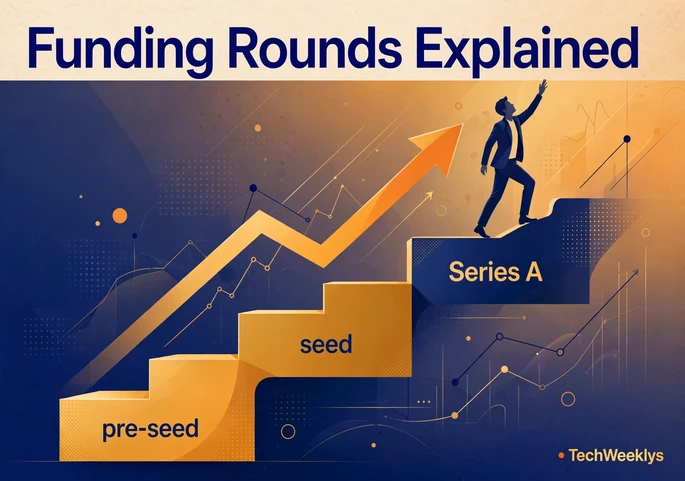
The startup funding ladder has four main rungs: pre-seed, seed, Series A, and beyond. Each round funds a specific phase of risk reduction, and each expects evidence appropriate to the check size.
Pre-seed capital supports early validation. Rounds typically run from $100,000 to $500,000, often raised from founders, friends, family, and angel investors. Investors at this stage bet on the team and the idea, not on revenue. What they want to see: a sharply defined customer, interviews with people who face the problem, a prototype or early pilot, and a list of assumptions you are actively testing.
Seed funding backs early evidence that customers want the product. Median seed rounds sit around $3 million, though the range is wide. Investors expect paying users or contracted pilots, retention signals, pricing data, a real go-to-market plan, and a credible 18 to 24 months of runway.
Series A finances repeatable sales and expansion. This is where the bar gets serious. A competitive Series A pitch in 2026 needs about $1 million to $2 million in ARR, growth near 3x year over year, net revenue retention above 120%, gross margins above 70%, and CAC payback under 12 months. Fewer than 15% of seed-stage startups make this jump, which is why Series A investors demand proof of a repeatable engine, not just a good product.
Series B and beyond scale toward category leadership or an exit. These rounds fund geographic expansion, major hiring, and the push toward profitability or an acquisition or IPO. If you want the full calendar view of where founders and investors actually meet, browse our upcoming tech conferences 2026 guide.
How Do You Raise a Pre-Seed Round?
Pre-seed is the round where early capital is most personal and least process-driven. There is no pitch deck factory here, just conviction and evidence.
Start with the milestone, not the money. Investors respond to founders who can say exactly what changes with their check. Specificity signals execution, not optimism.
Build your proof stack before you pitch. At pre-seed, proof means customer interviews with named pain points, a prototype people can click, early letters of intent, and a waitlist that grows without paid ads. You do not need revenue, but you need evidence that someone cares enough to act.
Tap the right sources. The typical pre-seed stack is founders’ savings, friends and family, and angel investors, plus accelerators and non-dilutive options like SBIR grants where you qualify. Angel checks are usually small and fast, and angels often open doors to the seed investors who come next.
Keep dilution light. Founders typically give up 15 to 25% of equity per round from pre-seed through Series A. At pre-seed, protect your cap table: a clean, founder-friendly table makes every later round easier. Use SAFEs (Simple Agreements for Future Equity) rather than priced rounds at this stage to keep legal costs and complexity down.
For the broader context of how tech weeks and demo days feed into these early rounds, see our pillar article on What Is Tech Week.
What Does It Take to Win a Seed Round?

Seed is where startup funding turns from belief into evidence. Investors are no longer buying the idea alone; they are buying early proof that the product solves a real need for real customers who pay.
The benchmark package for 2026 looks like this: $15,000 to $30,000 in monthly recurring revenue with 20% or higher month-over-month growth, engagement and retention data that show users love the product rather than just trying it, and a go-to-market motion you can describe in one paragraph. Vanity metrics like raw sign-ups do not move investors. Weekly-updated traction metrics do.
Your fundraising narrative should be built, not improvised. Start a fundraising memo on day one and update it weekly: the problem with data not anecdotes, the solution with screenshots of real usage, traction updated every week, a bottom-up TAM breakdown, an honest competitive section, and a team section that explains why you specifically win. When you meet investors, you will have months of accumulated thinking, not a deck you built in 48 hours.
Target 30 to 40 investors, not 200. Warm introductions convert roughly five times better than cold outreach. Build your network before you need it: attend demo days even when you are not presenting, help other founders with intros and feedback, and get known inside founder communities and accelerator networks. Demo days are particularly efficient for this, and our startup demo days guide explains how to use them.
Choose layered capital. The smartest 2026 founders do not pick one path: bootstrap to MVP from savings, take an angel round for early hires, add revenue-based financing for marketing spend, and grab equity-free grants where eligible. Layering keeps dilution below 15% through the first half million raised.
How Do You Prepare for Series A?
Series A is the round where startup funding stops being about potential and starts being about math. Fewer than 15% of seed-stage startups graduate, and the ones that do all share the same traits: proven product-market fit, repeatable unit economics, and consistent growth over six to twelve months.
Build the three answers into everything. Series A investors buy into a category, not just a product. Your pitch must answer three questions in under 30 seconds: why will this be a $1 billion company, why now, and why this team. If any of the three is fuzzy, you are not ready.
Make your unit economics undeniable. Investors want an LTV to CAC ratio above 3 to 1, net revenue retention above 120%, and gross margins above 70%. Never show cumulative charts; investors want monthly or quarterly growth they can verify. Your sales forecast should be grounded in actual conversion data from real deals, not top-down market math.
Run a real process. Once you have term sheets, do not sign the first one. Use competing interest to negotiate valuation, pro-rata rights, and board composition. After closing, create a tight 90-day deployment plan with three public milestones: one product, one revenue, one team. Public accountability builds investor confidence and sets up your Series A narrative, and eventually your Series B story too.
Time your raise to your metrics. The founders who close Series A fastest raise when their numbers are climbing, not when their bank account is empty. Start conversations when you are six months from needing the money, and let momentum do the negotiating for you. For the story of how the broader startup world operates, visit the TechWeeklys homepage for our ongoing coverage.
What Are the Biggest Funding Mistakes in 2026?
Founders repeat the same errors year after year. In a disciplined market, each one costs more.
Raising for the cash, not the milestone. Money without a plan evaporates. Every round should fund a specific inflection point: pre-seed buys validation, seed buys product-market fit evidence, Series A buys a repeatable engine. If you cannot name the milestone, you are not ready to raise.
Pitching too wide. Blasting 200 investors signals desperation and burns your reputation in a small industry. A focused list of 30 to 40 well-researched investors, approached through warm intros, beats spray and pray every time.
Leading with the market, not the customer. Top-down TAM slides tell investors nothing. Bottom-up math, how many customers at what price, built from your actual pipeline, is what closes rounds.
Ignoring non-dilutive capital. Grants, revenue-based financing, and accelerator funding are not consolation prizes. They extend runway without dilution and make your equity rounds happen at better valuations.
Treating the deck as the product. Investors fund companies, not slideware. A mediocre deck with real traction beats a beautiful deck with none. Build the company first, then tell its story.
Conclusion
Startup funding in 2026 rewards founders who treat fundraising as a disciplined campaign, not a lottery. Pre-seed buys you the right to prove the problem is real. Seed buys you the right to prove the solution works. Series A buys you the right to prove the business scales. At every stage, the formula is the same: name the milestone, build the evidence, target the right investors, and let momentum negotiate for you. Fewer than 15% of seed startups reach Series A, but the ones that do are not lucky. They are prepared. Start your fundraising memo this week, and make your next round the boring, inevitable result of a company that was already working.
Frequently Asked Questions
How much startup funding should I raise at pre-seed?
Pre-seed rounds typically range from $100,000 to $500,000, raised from founders, friends, family, and angel investors. Raise enough to hit one clear validation milestone, such as an MVP with paid pilots, and target 18 to 24 months of runway.
What is the difference between pre-seed and seed funding?
Pre-seed funds the idea and founding team before real revenue, with checks near $500,000. Seed funds the search for product-market fit, with median rounds around $3 million. Pre-seed bets on vision, while seed expects early traction and proof the product solves a real need.
What do investors expect at Series A in 2026?
A competitive Series A pitch needs roughly $1 million to $2 million in annual recurring revenue, growth near 3x year over year, an LTV to CAC ratio above 3 to 1, and consistent growth over six to twelve months. Investors want proven product-market fit and repeatable unit economics.
Can I get startup funding without giving up equity?
Yes. Options include non-dilutive grants such as SBIR programs, revenue-based financing, and accelerator funding. Layering these with small equity rounds keeps dilution below 15% through the early stages.
Read More
